Goodbye MQLs: Why product-qualified leads drive faster growth
With Amplitude’s powerful integration with HubSpot, marketers can drive eight times better conversions compared to marketing-qualified leads (MQLs).

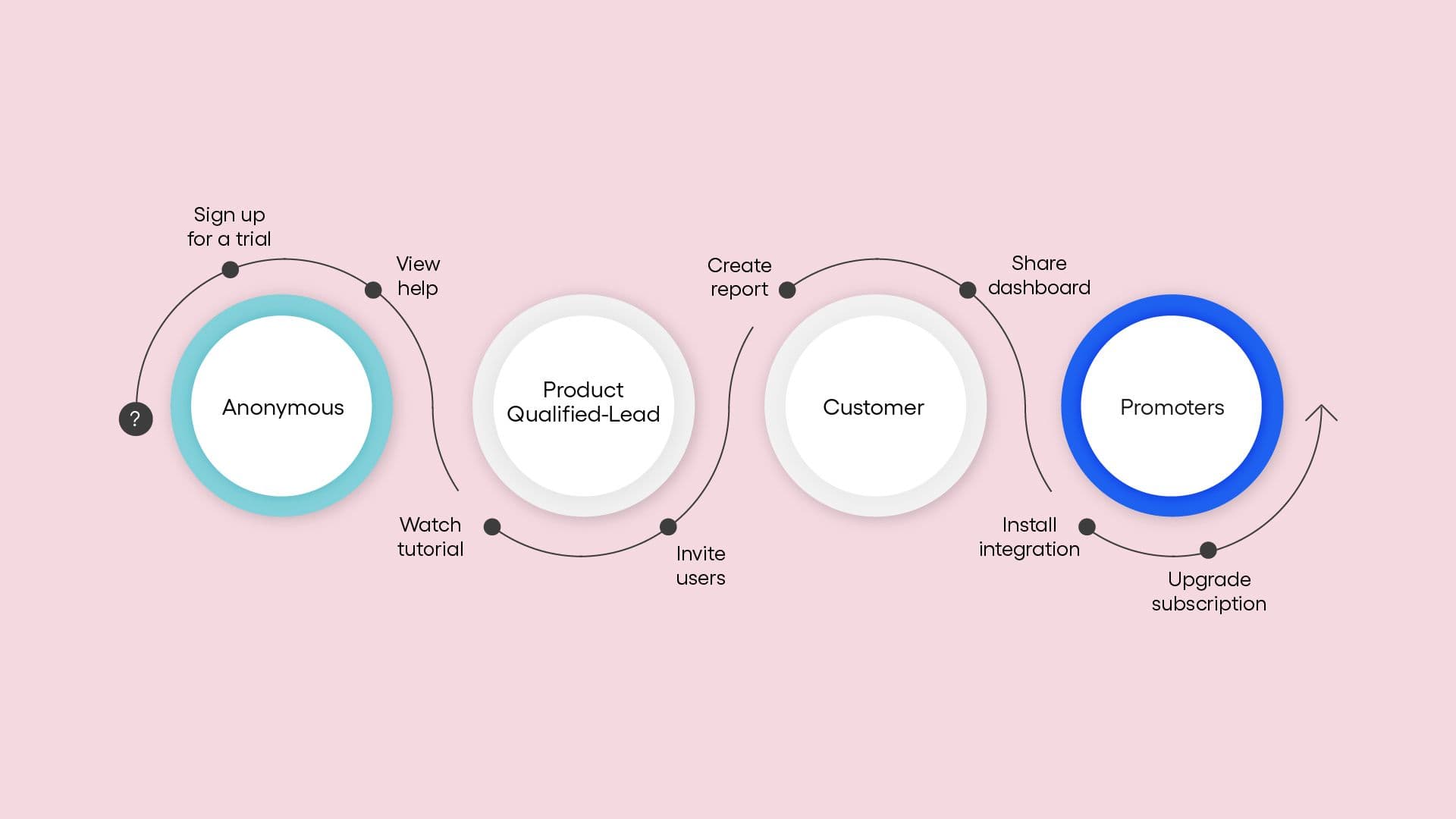
For years, marketers have been told to chase marketing-qualified leads (MQLs). MQLs have long been considered the pinnacle for organizations benchmarking the success of their marketing programs and investments.
But MQLs do a poor job of helping you understand what customers are doing in your products, demos, and trials. They don’t offer enough information about a customer’s behavior to help sales convert leads faster.
We’ve seen how this story unfolds numerous times. Though companies have been able to bring in a lot of MQLs, they haven’t done a great job at converting them. This is because MQLs don’t provide any context about what your customers are specifically interested in. And teams often fail to properly verify or qualify MQLs in the first place. According to DataDab, only half of B2B companies actually verify their leads today.
But fortunately, you’re in luck. Because “context” is where product-qualified leads (PQLs) shine.
A PQL is a user who has meaningfully engaged with your product—think a free trial or someone who has installed your product—and shows clear intent to convert to a paying customer. Unlike MQLs, PQLs signal high interest in your product, making them the perfect leads for sales to prioritize.
Why do PQLs matter?
According to Accenture, statistics show that PQLs are eight times more likely to convert than MQLs, with conversion rates often five times higher. While only about 2% of MQLs convert to paying customers, 25–30% of PQLs do, according to Tomasz Tunguz of Redpoint Ventures and SiriusDecisions.
Why are PQLs so much more efficient than MQLs? It’s simple: These prospects have already experienced your product’s value firsthand.
Despite these compelling numbers, only one in four companies currently has a formal PQL strategy. The challenge is that it’s tough for marketers to access product usage data and insights, let alone act on them.
Imagine how marketing teams could improve their campaigns if they knew which users had tried to set up an integration, watched a tutorial, or invited new users to their accounts. They would have a new way to leverage their content, understand how campaigns impact product usage, and surface the leads most likely to upgrade.
Enter HubSpot and Amplitude
Amplitude’s integration to HubSpot is a game-changer for marketers looking to streamline their PQL processes and pass high-quality leads to sales.
One of the most significant advancements in this integration is the ability to use Amplitude insights to power lead scoring in HubSpot. With Amplitude’s behavioral analytics baked into HubSpot, go-to-market (GTM) teams can tweak their lead-scoring models to account for these key conversion signals. This ensures they have the full picture of how their campaigns are driving product usage, what content users (not just prospects) are engaging with, and what types of behaviors are converting to pipeline and revenue. This enables marketers to target high-intent customers more effectively while identifying at-risk accounts before they churn.
Marketers can also sync Amplitude cohorts directly to HubSpot. This powerful feature fuels personalized campaigns and outreach at scale, ensuring users receive relevant content, messaging, and events based on their product usage.
Another exciting feature is that GTM teams can now access behavioral insights from Amplitude directly in HubSpot. Instead of switching between multiple tools, teams can track product usage data right alongside their traditional CRM data, all from within a HubSpot dashboard. This seamless experience enables businesses to understand the full picture of how their campaigns impact product usage in one place.
Amplitude is now a HubSpot Certified App, and we have streamlined the set-up flow to make it faster, easier, and more powerful. HubSpot customers can install Amplitude in just a few simple steps and bring the best of HubSpot and Amplitude together in one place.
Ready to start generating PQLs that convert?
Here’s how to get started:
- Install the integration from the HubSpot marketplace!
- Build a cohort of customers primed for upsell based on your product usage data.
- Build (or improve) your lead scoring model in HubSpot to score leads based on user behavior.
- Build a workflow to trigger automated outreach to drive conversion or hand off PQLs to sales once a lead shows a solid intent to buy.
- Use dashboards to track product usage and adjust outreach accordingly.
Our integration with HubSpot offers a powerful solution for GTM teams looking to optimize their funnel and drive faster growth with deeper customer insights.
Ready to take your sales funnel to the next level? Install the Amplitude App for HubSpot today and start driving better conversions.

Phil Burch
Former Group Product Marketing Manager, Amplitude
Phil Burch is a former Group Product Marketing Manager for Amplitude Experiment. Phil previously held roles across the customer lifecycle including account management, solutions consulting, and product onboarding before moving into product marketing roles at Sysomos, Hearsay Systems, and Tray.io.
More from PhilRecommended Reading

Lessons from consolidating our MCP server
Oct 6, 2026
10 min read

What AI engineers do in the age of agentic code
Oct 1, 2026
14 min read

An analysis of Jev: Faster and cheaper, but watch the accuracy
Sep 28, 2026
13 min read

Your agent isn’t broken. It’s guessing.
Sep 23, 2026
6 min read
Explore Related Content
9 Top Feature Flag Solutions for Modern Product Teams in 2026
Jan 27, 2026
Using behavioral analytics for growth with the Amplitude app on HubSpot
Jun 17, 2024
10 min read
Identity resolution: The secret to a 360-degree customer view
Feb 16, 2024
10 min read
Inside warehouse-native Amplitude: A technical deep dive
Jun 27, 2023
15 min read
5 Proven Strategies to Boost Customer Engagement
Jul 12, 2023
Designing High-Impact Experiments
May 13, 2024
9 direct-to-consumer marketing tactics to accelerate ecommerce growth
Feb 20, 2024
10 min read
Leveraging analytics to achieve product-market fit
Jul 20, 2023
10 min read