How We Redesigned Amplitude Docs for Agents and Made Everyone an Author
In our first 18 days live, AI crawlers fetched 60% more pages than people did. Here's how we rebuilt docs as a programmable surface.

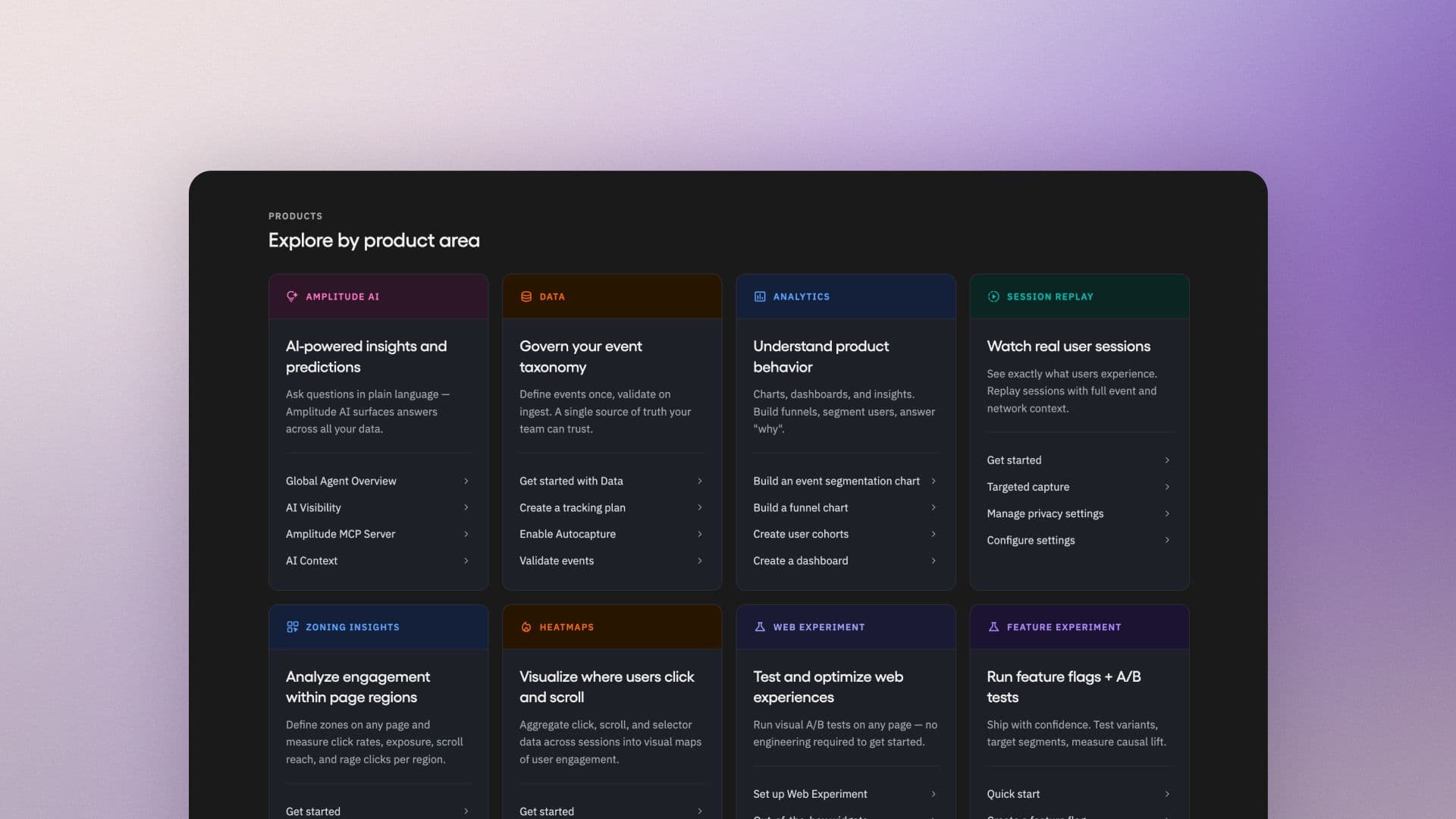
In the first 18 days after we launched the new Amplitude docs, LLM crawlers requested more pages than humans did. Bots accounted for 198,843 page views. In the same window, 37,561 unique humans loaded 124,044 pages.
The bots aren’t winning a popularity contest. They’re doing a job: answering questions about Amplitude on behalf of people who never visit amplitude.com/docs directly. That ratio is why we rebuilt the docs. The old site treated humans as the only readers worth designing for. The new site treats agents as a first-class audience and gives them, along with the humans they work for, a much shorter loop from question to answer to merged change.
This is the story of what we built, why, and what changed when we stopped treating docs as a website and started treating it as a programmable surface.
Why move off the old stack
Amplitude’s docs ran on a Statamic site for almost three years. It was fast, the editorial workflow was familiar, and the templates kept the design tight. Three forces eventually outgrew it:
- Build time. The old stack statically rendered every page during each build, so as the corpus crossed 800 documents, builds stretched past the point where contributors trusted the preview loop. A typo fix could take several minutes to render and verify, which is often longer than the fix itself took to write. A docs site that punishes iteration produces fewer iterations.
- Localization. The old stack assumed a deeply connected taxonomy in which every page sat inside collections and structured fields. That model can’t accommodate an automated translation pipeline that needs to mirror 800-plus English pages into Japanese, keep slugs aligned, and gracefully fall back when a translation hasn’t landed yet.
- LLM discoverability. The old templates produced clean HTML, but they didn’t expose structured metadata, raw Markdown, or a programmatic endpoint that an agent could reason about. The fastest-growing audience for docs is not a human in a browser. It’s an agent in a tool call. We saw that play out in the first three weeks of our redesign.
The brief for the new site was simple: Keep the docs-as-code spine, shed the deep taxonomy, optimize for fast iteration and translation, and treat LLMs as first-class consumers from the first commit.
The 49-day rebuild
The first commit landed on March 17, 2026. The site went live on May 4. In between: 495 commits, one primary author, and a small army of agent-assisted migration tasks. The shape of the work mattered as much as the timeline.
Day one was building the platform. In the first afternoon, the repo gained a Next.js 15 App Router scaffold, a YAML-to-JSON navigation compiler, a content resolution library, next-intl for locale routing, Amplitude SDK instrumentation, an AI menu, an MCP server with get_page, list_pages, and search_docs tools, Pagefind search, and an on-demand revalidation endpoint wired to GitHub Actions. Architecture first, content second. Forty-nine commits in a single day.
Weeks two and three were migration engineering. The single biggest pull request of the project moved content, navigation, and images out of the legacy system in one shot, using a programmatic Antlers-partial-to-React component map. Smaller follow-ups fixed Vercel build paths, rewrote internal links, and regenerated the sitemap. The corpus didn’t grow because anyone retyped it; it grew because we wrote the rewriter once.
April was the product surface. Markdoc replaced the early MDX bootstrap. The SDK catalog collapsed into a single /sdks index. The API reference got a catalog template and proxy routing. Hybrid semantic search, reranking, and a tuning harness landed over the course of the month and became the default ahead of launch. SEO got JSON-LD, per-page OG images, and a generated sitemap. The public Docs MCP server shipped. A doc review gate appeared in CI early in the month and was promoted to the single required check on the last PR before launch.
May 4 was operations. Sixteen commits in a single day to set the /docs basePath, fix asset URLs, fix API URLs, redesign the FAQ, point dev and preview URLs to the new docs, and clean up the migration artifacts. Nothing glamorous. The unglamorous list is what go-live actually looks like.
What the new stack looks like
The platform runs on Next.js 15 with the App Router and static generation, Markdoc for content, Tailwind CSS 4 for styling, and Upstash hybrid search for retrieval. Navigation lives in YAML under nav/ and compiles to a single docs.config.json at build, so the sidebar is data, not a template. Locales render through next-intl, with English in content/en/ and Japanese in content/ja/, falling back to English when a translation hasn’t landed yet. Build time dropped because static generation parallelizes cleanly, Markdoc parsing is cheaper than the old template engine, and the nav compile is a single pass rather than a per-page taxonomy lookup.
|
Old stack (Statamic) |
New stack (Next.js 16) |
|
|
Content format |
Markdown + Antlers templates |
Markdoc |
|
Build model |
Full rebuild on every change |
Static generation, parallelized |
|
Navigation |
Deep taxonomy per page |
YAML → compiled JSON, single pass |
|
Localization |
– |
next-intl, English fallback |
|
Agent access |
None (HTML scraping only) |
MCP server, raw Markdown API, JSON-LD |
|
Search |
Algolia DocSearch |
Upstash hybrid (lexical + semantic) |
Five things that make agents first-class readers
1. A public, read-only docs MCP server. Every doc page is reachable through a Model Context Protocol endpoint at amplitude.com/docs/api/mcp. The server exposes three tools, get_page, list_pages, and search_docs, over Streamable HTTP. An agent connected to this server can browse the corpus, search it, and fetch the raw page for any URL without scraping HTML. In the first 18 days post-launch, the endpoint served 4,262 completed requests.
2. A raw Markdown endpoint. Each page is also available as raw Markdoc at /api/content/[...slug]. The in-product AI menu uses this endpoint to power Copy-as-Markdown, Open-in-Claude, and Open-in-ChatGPT actions, so a reader can pivot any page directly into the agent of their choice. Early usage skews exactly how you’d expect a developer audience to use it: Of the 303 AI menu selections post-launch, 234 were Copy-as-Markdown (readers grabbing the source to paste into their own agent), followed by view-raw-Markdown, then Ask Claude and Ask ChatGPT.
3. Structured metadata on every page. Every doc page emits schema.org JSON-LD (TechArticle, BreadcrumbList, and FAQPage where appropriate) plus per-page Open Graph images generated at 1200×630 by next/og. Crawlers and link previews get the same structured signal that a human reader does.
4. Bot crawl analytics. The proxy layer logs every LLM crawler hit to Amplitude as an LLM Bot Crawl event. The tracked list mirrors our company-wide allowlist: GPTBot, ChatGPT-User, ClaudeBot, Claude-User, PerplexityBot, Google-Extended, Applebot-Extended, Meta-ExternalAgent, and the rest. The same instrumentation powers privacy-first MCP usage events (request completion, rejection, failure) with no raw queries, slugs, or response bodies recorded. We can see that ChatGPT-User is the dominant fetcher, that Bytespider crawls aggressively, and that Claude bots are growing, without touching what anyone actually asked.
5. Search built for hybrid retrieval. Search runs against Upstash Vector with both lexical and semantic ranking. A scheduled indexer reingests content/en/** only when source files have changed since the last successful run, and a 9-of-9 hit@1 eval gate must pass before the checkpoint advances. Result badges surface the product surface (Analytics, Admin, SDK) so agents consuming the search API get useful classification metadata, not just a URL.
Equipping agents to contribute, not just read
Reading is half the job. The repo also documents and tools the contribution loop so that agents can safely propose changes, and so the humans steering them can move faster.
Agent-facing guidance lives in five files at the repo root: CONTENT-AUTHORING.md for frontmatter and Markdoc syntax, COMPONENTS.md for available tags, DESIGN.md as the design-system source of truth, TRACKING.md for the instrumentation contract, and SEO.md for canonical URLs and sitemap behavior. The site is agent-agnostic. Claude, ChatGPT/Codex, and Cursor all work because the rules are written for any reader, not embedded in a single tool’s prompt.
The skill catalog is the lever that makes this practical. edit-doc applies the Amplitude style guide to a document. content-refine rewrites prose for translatability and LLM readability: short sentences, no idioms, no ambiguous pronouns, no gendered language. link-check and link-fix find and repair broken internal links across the corpus. feature-comparison audits the docs against shipped features and drafts missing pages on their own branches.
The shortest path to launching one of these agents runs through Slack. Claude and Cursor are both connected to a channel called #docs-vibe-author. Both agents have the full repo context and the skill catalog loaded on connect, so they can produce publication-ready content in most cases without anyone opening an editor. Someone posts, “The SDK quickstart is stale, please refresh it against the current browser SDK version,” and the agent picks the right skill, opens a branch, edits the pages, runs the style pass, and opens a PR. The thread becomes the work log. The PR carries a Doc-Reviewed-By: skill commit trailer, signaling to CI that the style pass already ran, so low-risk English edits flow through with a single required check instead of a full human pass.
That changes who can contribute to the docs. A docs typo or a missing SDK note used to require a human to open the repo, find the file, write the edit, and push. Now it requires someone to describe the problem in a sentence in Slack. The skill catalog and the review gate take it from there. Everyone at Amplitude is a docs contributor whether they know how to write Markdoc or not.
Compressing the GitHub loop
The shorter the loop from idea to merged change, the more often the corpus improves. Five workflow files in the repo do most of that work.
doc-review.yml runs on every PR. Its Review gate job is the single required check. Low-risk English doc edits with a Doc-Reviewed-By: skill trailer can merge once the gate passes. Higher-risk changes (code, nav, new docs, non-English content, prose changes over 200 words) still need human approval, but the gate is the only required check, so reviewers don’t chase stale failures. When approval lands, the workflow reruns failed jobs on the same commit and posts a single Doc Review Ready comment that @-mentions the author. A bi-weekly reviewer rotation routes higher-risk PRs to the on-rotation reviewer through GitHub and Linear.
vercel-deploy.yml posts one preview comment per PR, with the deployment URL, branch metadata, and direct preview links for up to three changed English pages. The page a reviewer wants to click is one tap away.
index-search.yml runs every six hours, reindexes only when content has changed, runs the 9-of-9 eval gate, and advances a search-index-last-success tag on success. Authors can force-dispatch the workflow when they need to bypass the checkpoint.
sync-sdk-metadata.yml keeps data/sdk-metadata.json current and only opens a PR when non-timestamp metadata changes. Code samples that reference {{sdk_versions.browser}} pick up new versions automatically.
smoke-canonical.yml validates canonical URLs, sitemap output, and robots behavior after every deploy, so the SEO contract documented in SEO.md doesn’t regress.
What this unlocks
The most interesting outcome is that the docs-as-code surface now has two equally weighted readers, humans and agents, and the contribution loop is short enough that either one can fix a typo, refresh an SDK version, or draft a missing page without waiting on a long build or review.
Eight hundred and thirty-four English documents and roughly 820,000 words are a lot to keep accurate. The bet behind this rebuild is that the only way to keep a corpus that size honest is to make every part of it (content, navigation, search, review, and deploy) legible to the agents that increasingly help write it, and accessible to the agents that increasingly read on behalf of users.
Three weeks in, the agents have already cast their vote. They’re reading more pages than humans are.

Mark Zegarelli
Principal Technical Writer, Amplitude
Mark Zegarelli is a Principal Technical Writer at Amplitude, where he focuses on the end-to-end documentation workflow. Previously, he was Senior Manager, Technical Documentation at Twilio. He has 20 years of experience in the software documentation space.
More from MarkRecommended Reading

Amplitude + GitHub Agents: Closing the Product Learning Loop
Oct 19, 2026
4 min read

Lessons from consolidating our MCP server
Oct 6, 2026
10 min read

What AI engineers do in the age of agentic code
Oct 1, 2026
14 min read

An analysis of Jev: Faster and cheaper, but watch the accuracy
Sep 28, 2026
13 min read