5 Agent Skills to Automate Your Weekly Product Review
How our teams use agent skills to run product reviews as PMs, engineers, and designers.

Just a few months ago, less than 1 percent of all insights generated in Amplitude were by agents using MCP. Today that number has multiplied by 20X and is growing fast. The signal is clear to us. Agents are quickly becoming the primary way people interact with their data and Skills make Agents smarter in Amplitude.
Sandhya Hegde at Calibre Labs put it cleanly recently: "the skill file is where institutional knowledge lives now". Figma is shipping skills that encode design system conventions and Intercom built a custom retrieval model hitting 65% resolution on customer support.
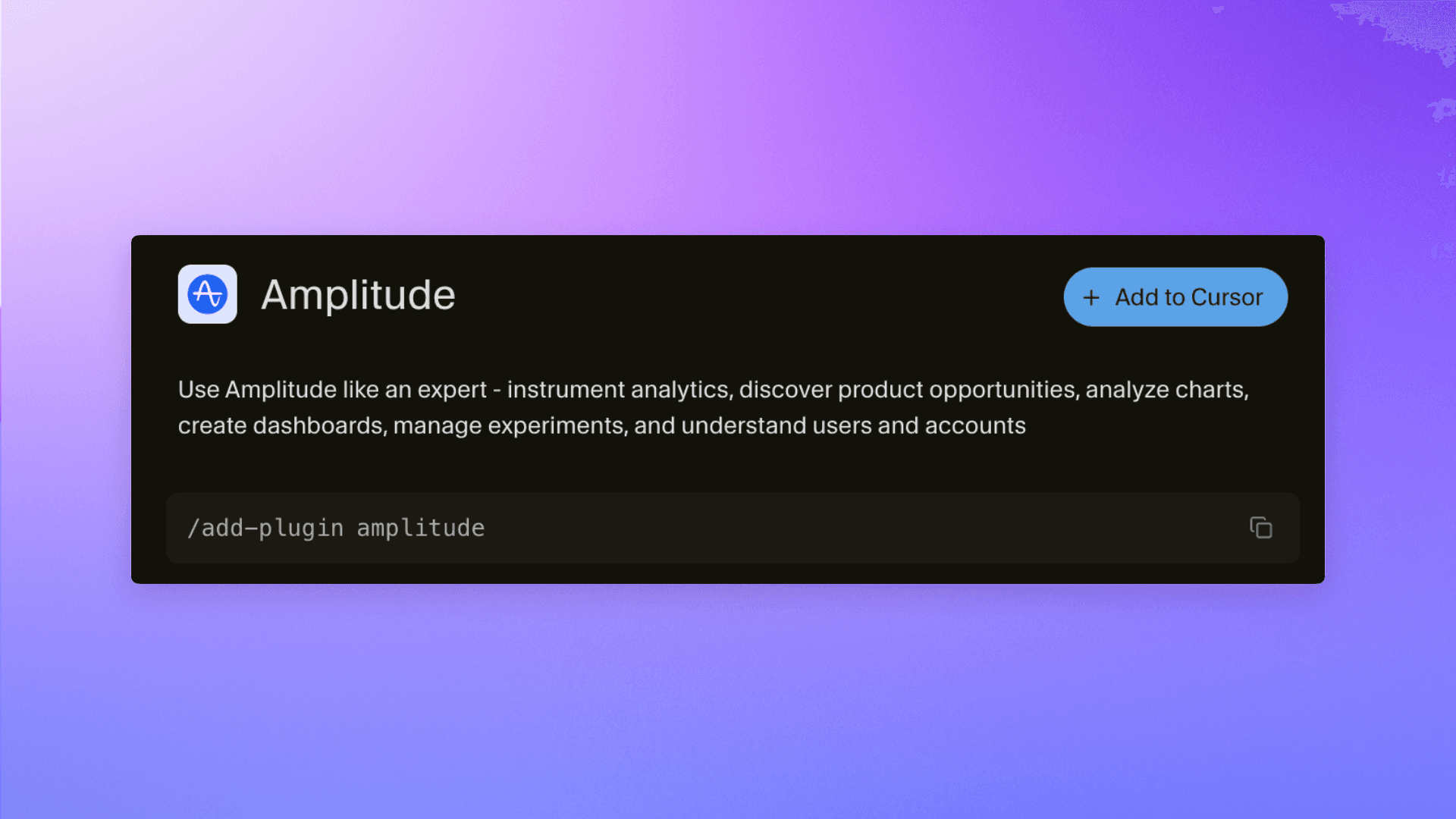
That's why we’ve launched Amplitude MCP Skills marketplace. Ten years of how Amplitude analysts actually run weekly reviews, audit replays, score opportunities, and read feedback, now packaged into skill files Claude, Codex, or Cursor can execute.
Here are five killer use cases our teams use to run product reviews as PMs, engineers, and marketers.
The Weekly Brief
Monday morning, before standup. You need a narrative on what moved last week.
The Weekly brief skill walks through six phases: context discovery, evidence gathering, trend detection, root-cause analysis, persona-calibrated narrative, actionable findings.
The judgment call it hardcodes is the one most agents miss: trends over snapshots. It compares the current week against a 4-week baseline, filters for confidence, and writes the output as a flowing email instead of a bulleted dashboard dump. It can even be calibrated based on your role.
Our PMs run this every monday morning and have something share-ready before standup. What used to be a 90-minute sunday chart pull can now be run as your standup zoom is loading up.
The UX Audit
So you shipped a new flow, activation dipped four points, and you suspect friction but don't want to spend an afternoon watching 20 session replays.
This skill automates watching session replays into a ranked friction map. It defines scope, gathers a quantitative baseline, extracts timelines from 8-12 sessions, and clusters patterns by severity: Critical (blocks completion, 50%+ of sessions), High (30%+), Medium (20%), Low (under 20%).
For each friction pattern it identifies, the skill can hypothesize why it happens and even Cross-reference with user feedback. If users are complaining about the same thing you're seeing in replays, that's a high-confidence signal.
This is one of the most popular use cases for our design and growth teams.
Analyze experiments
Running Experiments were never for the faint of heart.
Our Analyze experiment skill gives your agent the same superpowers as a data scientist. Design A/B tests with proper metrics and variants, analyze running or completed experiments, and interpret results with statistical rigor.
The skill runs the full ship/no-ship checklist a senior experimenter would. Data quality first. Was there an SRM (sample ratio mismatch ) Did all seven statistical validity flags pass? Capture primary, secondary, and guardrail metrics, with the real numbers: Revenue, retention, and bounce rate get checked automatically for regressions.
The skill even filters customer feedback to the experiment date range and surfaces themes that align with the variant's hypothesis, so the quantitative result has a story behind it.
Our teams use this skill when setting up experiments, checking experiment status, analyzing results, or making ship decisions.
Discover Opportunities
The "what should we prioritize" question, can now be answered.
This skill systematically mines Amplitude for signals — dropping funnels, stalled features, user friction, feedback themes, and experiment learnings. Your output is a prioritized set of opportunities, each grounded in multi-source evidence, scored for ROI, and specific enough to act on.
It synthesizes findings into RICE-scored opportunities (Reach × Impact × Confidence / Effort).
A finding only earns full presentation with multi-source evidence and a score ≥100. A single anomaly is a story but multi-source corroboration is what actually makes it onto a backlog. The output is a prioritized memo a PM or engineer can quickly ship with their coding agent of choice.
What would Lenny Do?
This is my personal favourite.
While the other four tell you what's happening; this one helps you decide what to do about it. The Lenny Skill answers product strategy, growth, pricing, hiring, and leadership questions using Lenny Rachitsky's archive. It searches Lenny Rachitsky's archive of newsletters and operator interviews, pulls the 2-4 most relevant pieces, and writes a concrete recommendation with sources cited.
The pairing is where it gets fun. Run discover-opportunities, get a list of RICE-scored bets, then ask "what would Lenny do?" The agent skill surfaces the most relevant frameworks, operator experiences, and hard-won lessons — then synthesizes them into a concrete, opinionated recommendation.
Skills are Increasingly how software companies hand decade-deep domain expertise to an AI agent. We're excited to see how teams use the MCP Skills marketplace to turn Claude, Codex, or Cursor into an expert product builder.
The Amplitude plugin is available now in Claude and Cursor’s plugin marketplaces, so you can make it part of your default context without any manual config or docs-reading. You can also download it from GitHub to install in Gemini or Codex. Try it out and let us know what you think!
Install the Amplitude plugin in your favorite coding agent today! Now available in the Claude marketplace, the Cursor marketplace, and in the Amplitude skills GitHub repo for use in Gemini and Codex.
For more information or if you have any feedback to file, visit the skills repo.

Nikhil Gangaraju
Director, Product Marketing, Amplitude
Nikhil is a product marketer at Amplitude focusing on Amplitude Analytics and works with teams to advance our mission to help companies build better products.
More from NikhilRecommended Reading

Amplitude Plug and Play: New AI Plugin in Claude and Cursor Marketplaces
May 1, 2026
5 min read

Introducing Amplitude Wizard CLI: Set Up Amplitude from Your Codebase
Apr 30, 2026
6 min read

Making AI Search Count (and Convert)
Apr 29, 2026
4 min read

How VEED Evolved Its AI Search Strategy
Apr 29, 2026
3 min read