Amplitude Pathfinder: Why Austin Costello is a Triple Threat Analyst
Discover how Amplitude super user Austin Costello leveraged soft skills to get C-suite buy-in and lead HSE’s migration from Google Analytics to Amplitude.

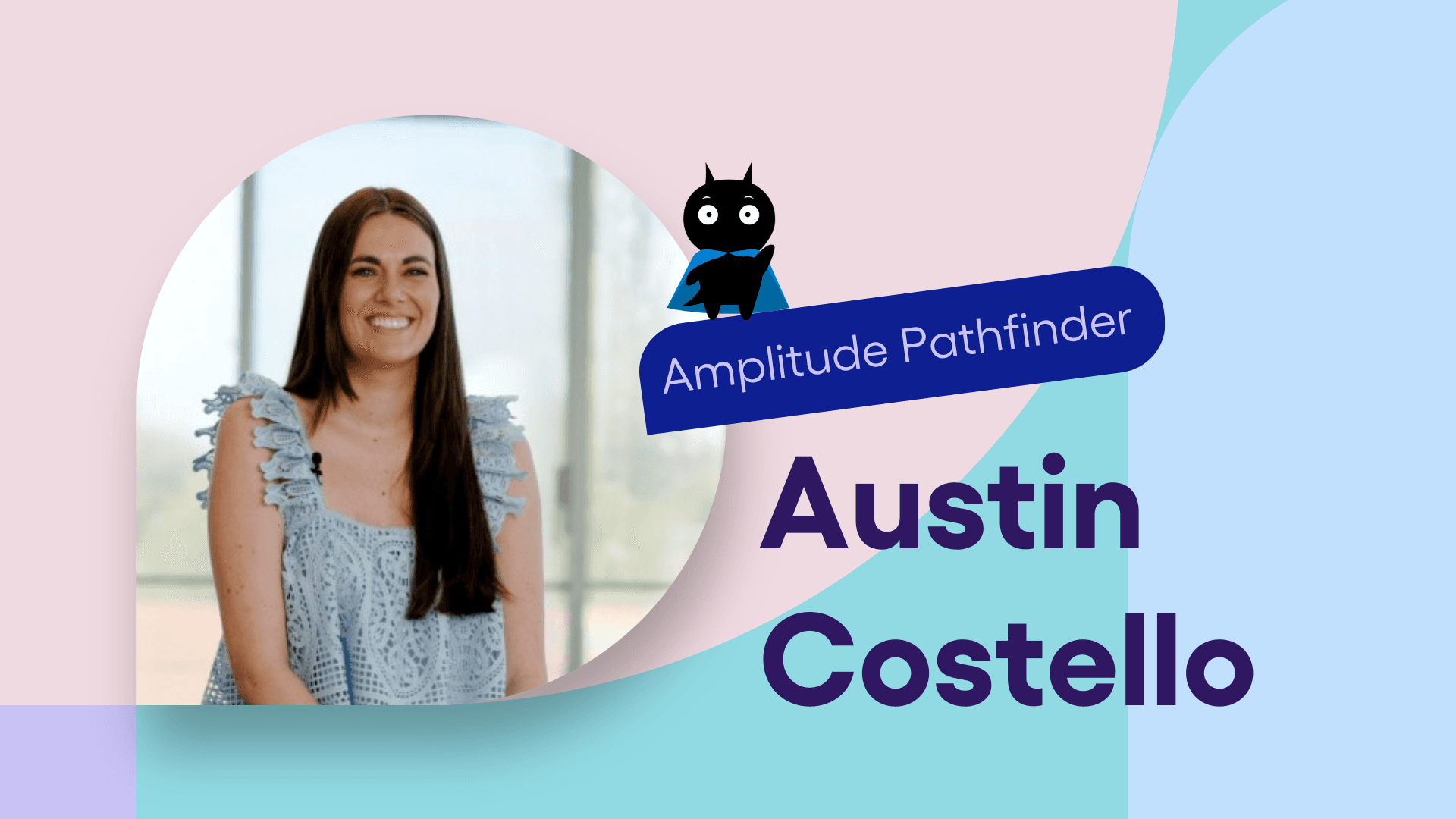
Amplitude Pathfinders are the quiet catalysts behind real change in Amplitude’s Cohort community. They are the analysts, marketers, founders, product managers, and devs whose often invisible work reminds us: data alone doesn’t move mountains. People do.
Today, I’m talking with Austin Costello, Team Lead of Customer Intelligence at HSE Home Shopping Europe and an Amplitude Pathfinder.
Austin gives us an inside look at her superpower: balancing the hard and soft skills necessary to bring about the kind of data culture we all hope for.
It’s Austin’s deep understanding of stakeholders, technical skills, and ability to transform business needs into real outcomes that makes her a true Pathfinder. It’s also why Austin is a core member of our elite Marketing Analytics Council—a group of five Amplitude power users who work hand-in-hand with our product team to influence our roadmap.
- Getting buy-in from the C-Suite as a junior analyst
- Leading her company’s switch from Google Analytics to Amplitude
- Her refreshingly straightforward advice for communicating the value of analytics to data skeptics: understand what matters to the stakeholder, then provide solutions
Beth: How did you get started in data?
Austin: I started out at a typical startup in San Francisco—fun, fast and chaotic, but every decision was based on feelings. Every time the CEO’s mood changed, so did our roadmap—it was frustrating and hard on the team.
I felt much more at home in my next role. It was a startup run by scientists where everyone lived and breathed data. But I still didn’t have the toolkit to really help make data-driven decisions. So, I went back to school for a Master’s in Business Analytics.
I remember my first semester, staying up all night on a project and having a blast, totally lost in the work. I knew then that I’d made the right decision to pivot my career, and I honestly haven’t looked back since.
I’m curious about a project you’re especially proud of, and what made it meaningful to you?
I was a junior analyst, less than a year into working at my last company, Mytheresa, when I had this idea to build a model to help predict who had potential to be a high value customer. I pitched it to my boss, explained how I’d do it, and convinced her to give me the time.
Looking back, I’m surprised she said yes! But I’m so glad she did. I did all the modeling, all the testing, and even pitched it to the C-suite. As far as I know, the model is still in use.
Interestingly, the technical side—building the actual model—didn’t take that long. It was everything else—getting buy-in, explaining the value, implementing it across the organization, that was the real challenge.
That’s also what made it so special. My work sparked others to try building models and opened doors for my teammates. That was the best part.
I love that. You did something new, created a business case, got it all the way to the top, and carved out time to do it away from your normal work. That takes conviction, risk-taking, storytelling, and expertise. What advice would you give someone in your shoes who wants to take that leap and reshape the business?
First, make sure you’re doing your job well. Set a good foundation. Sometimes junior analysts get excited about building models and AI, but they haven’t yet understood their data.
You really need to be able to paint the picture well to convince someone to give you a shot. Make sure that you come to the table, do the work, and understand the data deeply before saying, “Now I want to build something cool.”
Then, once you’ve established that foundation and have these ideas, advocate for yourself. There isn’t an idea that should be too small. Of course, your boss or teammates might prioritize differently, and you won’t always get a yes—that’s just the way it is. But that doesn’t mean you shouldn‘t try. Always take a risk on yourself, but first put in the work.
What skills have you developed through your work with Amplitude that you didn’t expect?
I’m most surprised by the soft skills, honestly. It's been over two years since we switched to Amplitude from Google Analytics. Obviously it was a huge change and a lot to ask from people in marketing, product, design, customer support, and sales when everyone’s got different comfort levels with data.
The key became education and ownership. I ran internal workshops, tailored for each group, to show them how data is collected, how Amplitude works, and then let them build their own dashboards and reports—with support as needed. The idea was to make everyone comfortable enough to actually use the tool themselves, not just send us requests.
That foundation was only possible because of the incredible work from my team members and our developers, such as Pierre Vieders, Svitlana Moroziuk, and Sertaç Artun, who built and maintained the underlying systems that made this kind of education and ownership sustainable.
Now, two years later, people flag bugs, ask for new events, and take the initiative to analyze data on their own. That’s the best sign of real progress.
The need for soft skills is a growing trend I’m seeing more broadly in this space. When people reach out to me looking for Amplitude talent, they want someone who can actually influence data culture. How do you communicate the value of analytics work to stakeholders who aren’t familiar with data?
I always try to use an example. Pick something that matters to them, and shape what you communicate around that. If I go to the checkout team and show them a marketing ROI report, they won’t care. But if I show them that half the people are bouncing at PayPal checkout, now I’ve got their attention.
It’s about understanding what’s important to that stakeholder and where they see value, then meeting them there with the data. Take the time to understand the person and the business needs first before anything else. You’ll start seeing patterns in how certain products, problems, or people tend to behave. I really paint a picture for them of a pain point or opportunity where they could make better decisions if they use data, and I serve it to them on a plate just to get that initial buy-in. Once I’ve got buy-in, it’s a lot easier to chip away at resistance and have more natural, open conversations rather than constantly trying to convince them.
Ultimately, it comes down to really understanding the problem and the person before jumping into solutions. Being solution-oriented is powerful, but unless you take the time to understand the problem or business goal you’re trying to solve, you might come up with the best solution ever—but for the wrong problem.
What’s one Amplitude feature you couldn’t live without?
I absolutely need the user profiles feature—it’s underrated, but I use it more than anything else. If a stakeholder comes to me with a question—like, “I want to measure this, but I don’t know which events to use”—I don’t have all the events and properties memorized, so the easiest way is to experience the user journey myself in real time.
And it’s great for collaborating with developers—we can send them a link showing exactly when a bug happened. No convincing needed, the data’s right there.
OK, final question: If you could build any feature for Amplitude, what would it be, and why?
A visual representation of the marketing customer path. Amplitude has lots of options for attribution logic, but I want to see it visually—like, first they come from a display campaign, then 50% go to paid search, then direct access. Having that in your face, easy to digest, would be powerful.
Do you use Amplitude to quietly (or loudly) drive change, build bridges between teams, or help others see the value in data? We want to share your story. Learn more about the Amplitude Pathfinders and apply to be featured!

Beth Saunders
Senior Community Manager, Amplitude
Beth leads engagement programs that foster connections within both the Amplitude community and the broader product analytics space. Before this role, she served as the Senior Data and Analytics Manager at Mysa Smart Thermostats, where she drove data-informed decision-making using Amplitude and other tools. As a previous Amplitude customer, admin, and champion, Beth's passion for data and technology is undeniable. Additionally, she brings a decade of marketing experience from rapidly growing startups.
More from BethRecommended Reading

What’s New with Amplitude Agents
Apr 28, 2026
4 min read

Effortless Support at Scale: Making Human Support More Human
Apr 28, 2026
11 min read

AI Week 2026: Upleveling All Together
Apr 27, 2026
11 min read

Amplitude AI Builders: Paul Hultgren Chats about AI Assistant
Apr 24, 2026
10 min read