Amplitude Pathfinder: Jamie Dunbar Smyth’s Obsession with Growth
Learn Jamie’s approach to 10+ successful Amplitude rollouts, his onboarding exercise for new hires, and why he champions simple dashboards for real results.

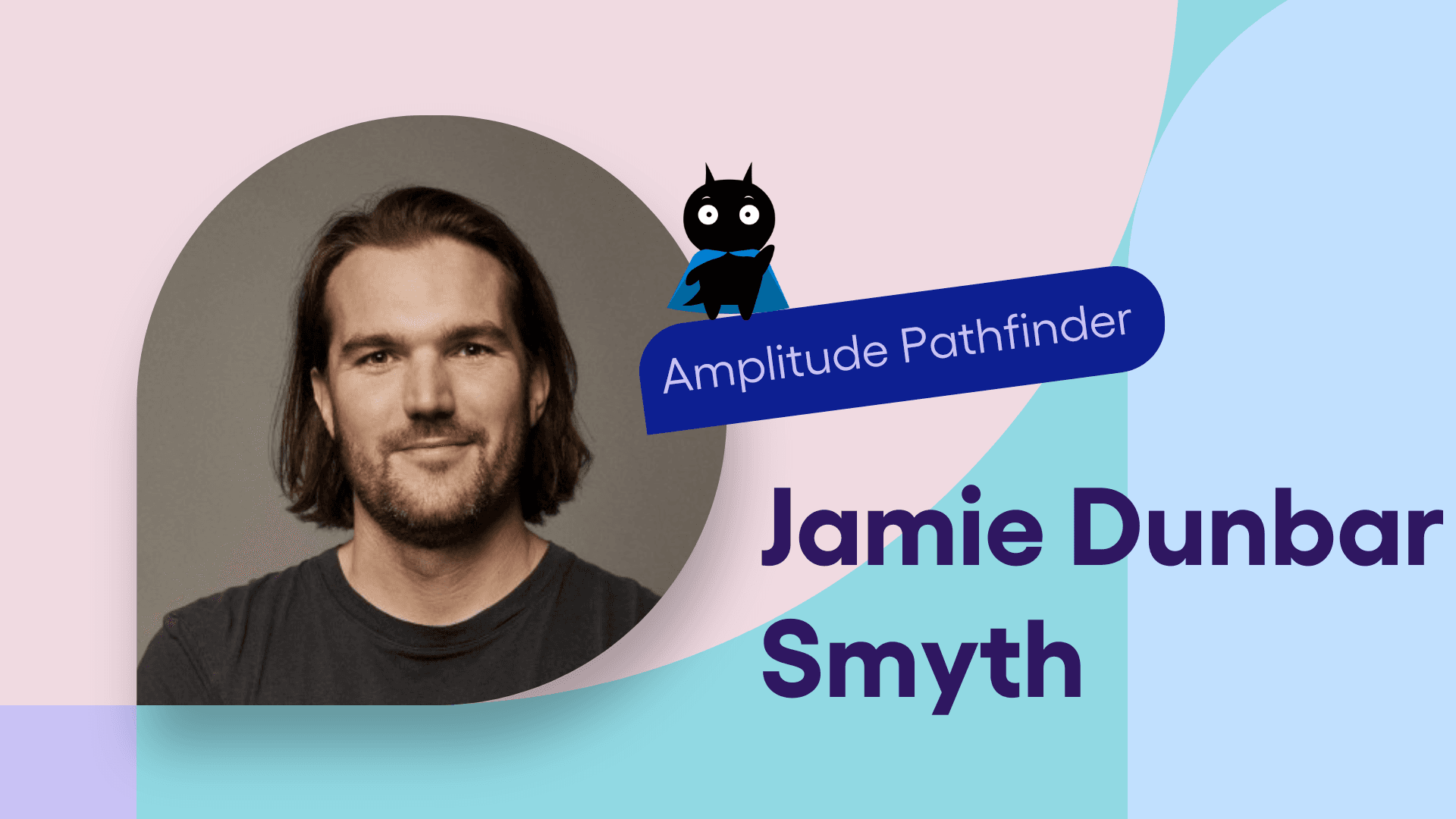
Amplitude Pathfinders are the quiet catalysts behind real change in Amplitude’s Cohort community. They are the analysts, marketers, founders, product managers, and devs whose often invisible work reminds us: data alone doesn’t move mountains. People do.
Today, I’m talking with Jamie Dunbar Smyth, growth advisor to some of the fastest growing ecommerce shops in Sweden and formerly Head of Growth at G-Loot, a fan-favorite esports platform.
In this interview, Jamie shares his approach to data and growth: keep things simple. Whether you’re an early-stage startup or a scaling enterprise, Jamie believes that the basics of a strong data foundation and clear, priority metrics unlock the most value.
Jamie shares the lessons he’s learned from a decade in data, including the one challenge that still keeps him up at night: attribution. As marketing channels multiply and costs rise, pinpointing what really drives ROI is more important—and more difficult—than ever.
- How Jamie builds solid analytics foundations with minimal complexity
- Why simple dashboards outperform complex reporting for most teams
- Advice for those starting with Amplitude or joining a new analytics team
Beth: How did you get started with data? What's your story?
Jamie: My first real introduction to the world of data was studying as a biochemist at Imperial College in London. Experimentation was at the heart of everything I did there.
Right after my Master’s, I jumped into a Swedish consulting company where we’d build games in Excel to model businesses and tell stories through data. We’d create an Excel model for launching new Nike stores and compete in these made-up scenarios, fighting for market share. The model would spit out data, and we’d have to analyze it on the fly to tell a story that convinced people the strategy worked.
That’s when I understood how data could answer the “why” questions of strategy. From there, I transitioned into product development and built a learning experience platform that captured data from 360-degree reviews, pulse surveys, and simulations, aggregating it at a personal level to determine if our communications and tests were actually shifting people's knowledge and behavior.
And when did you first start using Amplitude?
I was introduced to Amplitude in 2019 while listening to an audiobook called Hacking Growth by Sean Ellis and Morgan Brown. Shortly after, I joined a company in Sweden on an aggressive growth journey, and I needed to build a martech stack that enabled “autonomous BI,” where people didn’t require a centralized business intelligence team but could build their own data muscle. Amplitude naturally became a key part of that stack.
What’s a recent challenge that kept you up at night?
That’s a really tough question … I guess there aren’t that many things that keep me up at night, because I can answer all my questions in Amplitude! I’m only half-joking. OK, here’s one: Growing profitably keeps me up at night—where to spend the money.
Marketing channels are becoming increasingly expensive, CPMs are going up, and it’s becoming harder and harder to break through the noise. I work with many small teams who have found product-market fit and are looking to scale a great product or ecommerce experience. The biggest challenge for them is attribution.
We’re spending money in different places, but what actually drove the ROI? What drove the uplift? Was it TikTok? Was it Meta? Both platforms claim they’re the winning platform. When I do last-click attribution in Amplitude, it shows Google—but we all know you don’t typically discover products through Google.
This is especially critical for small businesses for whom spending $100 a day is a risk and who need to get back at least $400 to be profitable.
What’s one Amplitude feature you couldn't live without?
The Formula is a big part of what I do, funnily enough, with segmentation graphs. Formula with metrics is key to everything I work on, so I couldn't live without that.
How has working with Amplitude shaped your career path?
It’s made me realize how easy it is to answer questions about your business, performance, and customer behaviors—on-site or in-platform—if you have a good data structure. And what’s been really eye-opening is that it isn’t actually that complicated to get to this stage. You can get really far with minimal effort if you focus on your priority events. Get clean priority events into Amplitude, and you immediately see value.
I’ve been particularly impressed with the evolution of the experimentation features and now Guides and Surveys. It’s phenomenal how easy it is to set things up and run experiments compared to the traditional developer-heavy approach. I see that shaping my future career trajectory in a big way.
All of which is why Amplitude has become my go-to tool since becoming an independent consultant. I’ve implemented it over 10 times in the last two years.
I actually wanted to ask about that—what makes you stick with being an independent consultant versus going in-house?
I quite enjoy the variety of helping people across different businesses with different challenges. Plus, it gives me time to work on my own things as well. When working in a company, you just never find time for yourself. You’re a little bit more protected with your time when you’re working as an independent, and you have a lot more flexibility.
I have three young kids, so flexibility is key at this stage. Who knows? Maybe in the future it’ll be more fun to be a part of an embedded team.
What have you learned from working with customers and bringing them onto Amplitude that surprised you over the last few years?
I’ve learned to ask smarter questions and focus on less. Initially, I’d build out many different graphs and dashboards, but I’ve realized it’s better to keep it simple and focus on the metrics that are most relevant to the clients I work with.
I think this applies whether you’re external or internal. Creating too much can be overwhelming, especially when people are at different stages of their analytics journeys. I typically don’t do more than 3–4 core dashboards for clients, keeping them very simple so they can understand them easily. I keep the more complex analyses to myself and show snippets when required.
This approach works well internally too. If an organization doesn’t have a culture of looking at data daily, overwhelming them with complex dashboards can be counterproductive.
Such a good point. Keeping it simple seems like it requires a lot of confidence in your ability to look at the data and understand how it's structured?
In the growth space you’re constantly looking at rolling numbers. So you have a quarterly target, and to get to that quarterly target, you need to hit monthly numbers. You want to make sure that on a rolling 30-day basis, you're growing towards that monthly number.
It’s very much about figuring out the metrics that matter, and then having those different lenses, because you're always making daily adjustments. You’re changing campaign budgets, launching new creatives, spinning up new landing pages. There’s this always-on approach where you constantly need to keep a tab on things. That’s why it’s really important to keep it simple, because it’s so complex.
If you could give one piece of advice to someone just starting with Amplitude, what would it be?
Go and read all the documentation.
Jamie come on, easier advice please.
OK … Go through Amplitude Academy. Understand the data foundation. Understand your data. Get this information from your data engineers or data team so you can become knowledgeable about the data structure. Once you understand the data, the tool itself is easy to learn.
What would you say to someone who’s just joined a new team that’s using Amplitude? That’s a big point of friction where either someone is really motivated or, in some cases, they just give up.
Honestly, the first thing I’d do is get everyone using Amplitude’s Event Explorer.
Ideally, you’d have a Figma file with every event and property perfectly mapped, but let’s be real—it’s almost impossible to keep that up to date. So, as part of onboarding, I have every new team member go through the customer journey in Event Explorer, watch what happens, and take screenshots as they go. That way, they get to know the most important events and properties and can build out their own Miro board of the journey.
If you could build any feature in Amplitude, what would it be?
(laughing) I would have an Amplitude app on my phone.
Seriously, when I was using Shopify, checking the Shopify app became an addiction. I was looking at it every single day.
I would love to look across the data quickly on my phone. I don’t want to do analysis. I just want to look at the key graphs. It can be the silliest and dumbest app out there with one view or a few views and that’s it. You can’t do anything else. I’d use that all the time.
Do you use Amplitude to quietly (or loudly) drive change, build bridges between teams, or help others see the value in data? We want to share your story. Learn more about the Amplitude Pathfinders and apply to be featured!

Beth Saunders
Senior Community Manager, Amplitude
Beth leads engagement programs that foster connections within both the Amplitude community and the broader product analytics space. Before this role, she served as the Senior Data and Analytics Manager at Mysa Smart Thermostats, where she drove data-informed decision-making using Amplitude and other tools. As a previous Amplitude customer, admin, and champion, Beth's passion for data and technology is undeniable. Additionally, she brings a decade of marketing experience from rapidly growing startups.
More from BethRecommended Reading

Amplitude + GitHub Agents: Closing the Product Learning Loop
Oct 19, 2026
4 min read

Lessons from consolidating our MCP server
Oct 6, 2026
10 min read

What AI engineers do in the age of agentic code
Oct 1, 2026
14 min read

An analysis of Jev: Faster and cheaper, but watch the accuracy
Sep 28, 2026
13 min read