What is Product Intelligence?
What is product intelligence and why does it matter? Amplitude CEO Spenser Skates explains how digital leaders are using this new category of software to build great product experiences that convert and retain customers.

Product intelligence software helps teams use their customer data to build great product experiences. As every traditional business accelerates investments in digital transformation and more of our lives are spent using digital products, there has been a big shift in the relationship between consumers and the creators who build products for us all.
Product intelligence is a response to these shifts—changes in how we interact with products, and how companies are competing to retain, delight, and engage customers. It is also about changes in how cross-functional teams access, make sense of, and act on complex behavioral data.
Understanding these shifts—and where product intelligence fits into your roadmap—will help you retain customers, and support sustainable, product-led growth. And your teams will connect more deeply with their work, and find new and creative ways to help the humans outside the building, your customers.
Which is really where it all starts…
Choice and Experience
To understand product intelligence, we first need to explore our personal relationships to the products we use (and stop using).
Today, we—the product-using public—have more choices. We are also more connected—tablets, watches, phones, work laptops, TVs, bikes, consoles, and cars to name a few. And all those choices, and those screens, are turning us into experience snobs. If products do not entertain us, make us more effective at our jobs, connect us, inform us, delight and inspire us—we fire them and try something new. Our loyalty must be earned.
73% of buyers claim experience #1 factor to loyalty…and loyal customers are 5X more likely to purchase again.Gartner
So naturally this is where companies are trying to compete and earn our loyalty: by offering differentiated experiences across our connected (and offline) lives, and by using data to better understand our complex relationships with the products we love.
We’re seeing this shift across many verticals including banking, media, healthcare, and consumer goods. “We are a burger company,” explains Elie Javice, VP of Tech Product Management from Restaurant Brands International (Burger King), “that is our product. It’s not a website. But to stay relevant, we have to do a lot more than sell Whoppers. Today more than ever it’s important for us to think about experiences people are going to have with the Burger King brand that will be relevant and establish a meaningful, emotional connection.”
The Stakes Are High
What happens to the companies that fall behind?
They lose customers. So…they have to pay more to attract new customers. They desperately throw money at trying to keep those customers. But customers leave anyway, and the company loses market share and falls further behind. Meanwhile, internally there is a drop in morale, less sense of impact, and more reactive decision making. The stakes are high. It’s a wicked, self-reinforcing loop.
The Path Forward
So how do you chart a different course? The best digital teams have a couple things in common when addressing these challenges. They:
| Connect to Customers | Interact directly with customers, with rapid feedback loops, more signal, and less noise. |
| Understand the Customer Journey | Have a complete view of the customer journey. From page views to full end-to-end experiences across devices. |
| Data Literate | Are able to ask and answer their own questions, make data-informed decisions, and tell stories with data. |
| Sustainable Growth | Optimize for engagement and lifetime value (the “continuous launch”). |
| Shipping and Learning in Balance | Ship as fast as they learn, and learn as fast as they ship. Sustainably and consistently. Deliver compelling experiences. |
| Innovate | Discover step-changes that change the game in meaningful ways. |
Companies that operate this way enjoy improved outcomes: higher revenue performance, increased loyalty (and lower churn), and faster innovation. And companies having difficulty adopting these practices experience 32% lower revenue growth and are slower to catch up.(McKinsey, The business value of design, October 2018).
The Gap
So we know what good looks like, but how do you put it all into motion?
First you have the necessary cultural shifts. It starts with providing teams with direct access to customers and meaningful qualitative and quantitative insights. The next shift is empowering teams to run safe-to-fail experiments that yield valuable insights. To make sense of those insights, the team needs data literacy. These shifts require letting go of the notion of “delivery” teams, and replacing it with the idea of “problem solving” teams.
In addition to these big (and important) culture shifts, you’ve got a range of formidable technical execution challenges: accelerating delivery and experimentation, a firehose of streaming data from diverse sources and different points in the customer journey, interoperability with a whole ecosystem of tools & services, and identity resolution and user management. All while enabling self-service across lots of teams.
If this is already your world, you can likely relate. If it isn’t, someone in your company is probably worrying about it (or will be when your org leans into this journey).
Product Intelligence
This is where product intelligence comes in (and why it is different in obvious and subtle ways).
What Is Product Intelligence?
Product intelligence helps teams use customer data to build great product experiences that convert and retain users. It is integrated and easy-to-use software for all teams impacting the digital experience, so they can better understand their customers, ship the right product experiences faster, and drive measurable business outcomes.
How does product intelligence differ from, say, business intelligence, marketing analytics, data visualization, or CDPs. It boils down to the need the product is filling…
Marketing analytics, for example, is hyper-focused on optimizing your ad spend and initial conversion. It’s about campaigns, page views, and linear funnels. BI tends to be about breadth—generalized reporting across business operations to support a wide range of business decisions. Data-visualization focuses on, well, visualizing data. Customer data platforms, according to Gartner, focus on “data collection, profile unification, segmentation and activation.”
Enter the rise of products and experiences. The game of product-led growth is unique, and unique challenges require new classes of products. With product intelligence you are tackling three unique things:
- Highly complex behavioral data resulting from complex experiences (stretching over variable timespans, and diverse contexts)
- The unique ways cross-functional product and growth teams—and teams of teams—collaborate…in “real time”, back-and-forth, embracing the beautiful mess
- How digital teams take action (iterative, integrated, personalized, moving fast), and the insights needed to understand the impact of those actions.
As any astute product manager, designer, or engineer knows, you can’t be all things to all people. The unique demands of product development require a unique approach.
Product intelligence supports the shifts…
Two Key Product Intelligence Principles
Two key principles have emerged in our work with a wide range of digital teams:
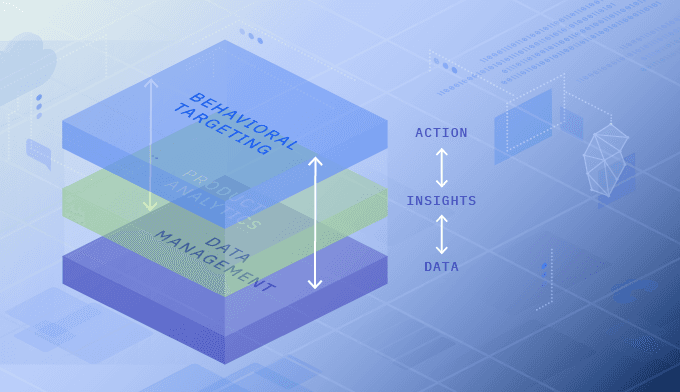
Principle #1 You can’t isolate analytics, customer data management, and experimentation and behavioral targeting from each other and expect to be able to optimize the product experience at scale.
You can have the best charts, analysis, and data exploration tools but without the right data—useful, trustworthy, understandable, and accessible data—you’ll struggle. A well managed taxonomy and lightweight governance are invisible force multipliers. But it can’t stop there: the whole idea is taking action and making better decisions.
There are three critical product intelligence capabilities:
- Product Analytics: Real-time analytics to monitor, drill-in and explore user behavior and cross-platform digital journeys. Understand the impact of product bets.
- Customer Data Management: Data pipelines that are comprehensive, yet codeless with tools to govern data and accessibility. Architect accurate and controlled windows into behavioral data.
- Behavioral Targeting & Experimentation: Integration to platforms like Braze, Facebook, Intercom, Iterable, Salesforce, and more. Connect data easily to other tools to power personalized experiences and analyze results instantly. Keep pace with frequent releases, and help teams understand how those releases improve experiences and increase customer lifetime value.
Principle #2 Platforms and integrations do not get you a great product experience. Teams do, and you need to help them collaborate more effectively. Collaboration cannot be an afterthought.
Modern product teams are cross-functional and highly collaborative. The back and forth is fluid, fast-paced, non-linear, and builds on itself. With traditional reporting and BI, a team needs to frame its questions upfront. They submit a ticket, wait, and get a report or dashboard back. For product work, this waiting game is untenable; you need to be able to keep pace with rapid question-asking, exploration, and decision making. It is a team sport.
“A product manager will share a chart, and then a designer will click in and explore it and ask a follow up question,” explains Maura Church, Head of Data Science at Patreon, “or data scientists will group it by another way and dig into something a little bit deeper.”
Product development is iterative. The loop—ask, act, measure, and share—matters. Collaboration in our mental model doesn’t stop at granting access to dashboards and notebooks. You actually need to help nudge teams around the learning loop.
You can extend this learning loop to the org itself. There is a network effect at play when it comes to becoming more impact-driven. Progress starts with a handful of individuals or teams. Other teams notice what is happening—notice the observable impact—and want to be part of it.
In Closing
Product intelligence helps teams use customer data to build great product experiences that convert and retain users.
It is a response to the high stakes challenge of exploiting a proliferation in consumer choices, experience as a key differentiator, and the resulting complexities inherent to cross-device experiences (and all the data that generates). The companies that can solve this puzzle will win.
To conclude, we would like to bring this back to where we started — choice, experiences, and connection. The human angle — helping our customers help THEIR customers — is extremely important to us here at Amplitude. We value partnering with you in the product intelligence journey.
To learn more, download our Product Intelligence Report and find out how successful businesses operate with product-led growth.

Spenser Skates
CEO and Co-founder, Amplitude
Spenser is the CEO and Co-founder of Amplitude. He experienced the need for a better product analytics solution firsthand while developing Sonalight, a text-to-voice app. Out of that need, Spenser created Amplitude so that everyone can learn from user behavior to build better products.
More from Spenser


