Designing for Impact: 4 Product Design Principles from Technically Speaking's Harrison Wheeler
Get to know the winner of this year's Product 50 Best Product Design Leader

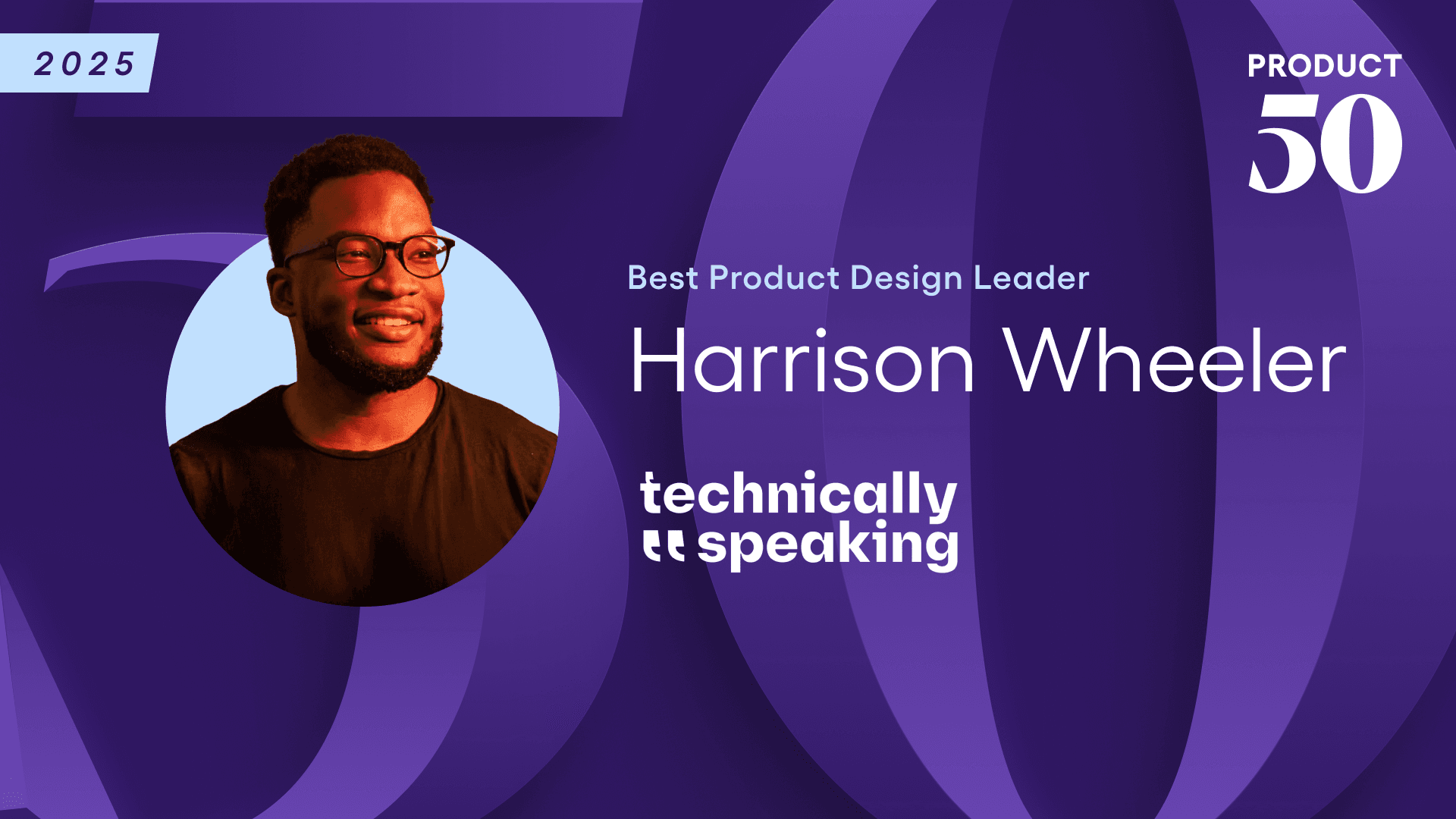
We recently announced the Product 50 class of 2025, a list of the world’s best and brightest product and growth leaders. This year’s winners and finalists are driving change, empowering teams, and revolutionizing their industries—and they’re a rich source of knowledge and expertise.
We’re proud to spotlight their career journeys, inspirations, and unique perspectives on the trends shaping the digital product landscape.
Meet Harrison
Harrison Wheeler was a design leader at LinkedIn from 2017 until just recently—almost eight years! In his most recent role as the Director of Product Design, he led a team of designers who created seamless, engaging, and impactful user experiences for the LinkedIn Marketing Solutions platform. In addition to enhancing product experiences, increasing operational efficiency, and drastically scaling the design team, he actively fostered inclusive networks and global knowledge sharing.
Harrison co-founded Black by Design, an internal network that connects Black designers at LinkedIn and establishes a pipeline for emerging talent. He’s also the host of Technically Speaking, a podcast that explores the human side of design and technology.
Harrison’s mission is to inspire the next generation of design leaders. He generously shares four pieces of advice that he believes are crucial for design success.
1. Scale your design team using a clear narrative and hands-on approach
Scaling your team is no easy feat—especially when you quadruple its size like Harrison did (from 6 to ~24 members!). From justifying headcount to hiring, onboarding, and developing design talent, Harrison emphasizes the importance of flexibility, relationship building, and strong leadership.
“There’s no ‘silver bullet’ to growing your design team,” Harrison says. “Every team and situation is different, and leadership is seasonal. What works today might not work tomorrow, so stay flexible.”
One constant, however, is the importance of developing a clear point of view and iterating on your messaging to build a justification narrative that resonates with other leaders. “Remain consistent in that narrative, and be prepared to have challenging yet essential conversations. Often, those tough and uncomfortable conversations are at the center of any goal you want to achieve.”
For example, to gain support for additional headcount, you need a strong pitch and narrative around the quality gaps that emerge when you don’t have enough designers. “Asking the same number of designers to just 'do more' isn’t the answer,” Harrison says.
He backs that up by tracking every project request for the design team and saying “no” to any that would overextend his team. This enables him to protect his team’s capacity and demonstrate the quality gap between projects where designers are and aren’t involved.
Harrison also believes balancing priorities and safeguarding your team’s capacity is key to developing a thriving design practice. “Time is currency, so we’re very disciplined about saying no to work that isn’t a priority, proactively identifying scope creep, and collaborating with the product organization to identify and support the most impactful business initiatives.”
When new designers join your team, Harrison emphasizes setting clear expectations and prioritizing meetings with cross-functional peers. “Having a beginner's mindset is grossly underrated,” he says. These meetings give new folks visibility into what other teams are working on and an understanding of how their contribution ladders up the business. “I believe it takes two years before making a meaningful impact. Trust and relationships play a big role in accelerating that.”
Be prepared to have challenging yet essential conversations. Often, those tough and uncomfortable conversations are at the center of any goal you want to achieve.
2. Break transformations into manageable steps
Harrison’s team played a critical role in transforming LinkedIn’s Campaign Manager from its Web 2.0 paradigm to a modern self-serve platform that enables businesses to create, launch, and manage their LinkedIn advertising campaigns. As a result of this transformation, advertisers can successfully connect with over 1 billion LinkedIn users! Since most companies face the same (daunting) task of transforming legacy products for modern users, we were eager to understand Harrison’s approach.
“We recognized a fundamental shift in business models from long-term contracts to self-serve in B2B SaaS,” he says. “Users’ expectations have been influenced by product-led growth companies like Slack and Notion, and we understood that a good user experience and ease of onboarding were becoming competitive advantages.”
When their product and user behavioral data confirmed this, Harrison’s team focused on developing a strong point of view regarding their position in the market. “This helped leaders and other functions understand how the project fit into the system from a business perspective,” Harrison says. Their efforts paid off—the LinkedIn leadership team agreed with their view and elevated the design team’s platform.
A challenge in any large-scale transformation is delivering on project milestones while maintaining day-to-day service continuity. Harrison stresses the importance of starting with a pilot. This enables the team to identify larger themes, develop a clear vision for each pillar of your transformation, and craft a compelling narrative to gain buy-in and momentum.
One of Harrison’s greatest pieces of advice related to managing product transformation is that not every idea will land, and that’s OK. “Sometimes the timing’s off. Sometimes your story needs work. But that doesn’t mean you give up,” he encourages. “Reframe it. Re-pitch it. Build your ‘board of directors’—your cross-functional crew—to help pressure test, shape, and champion it.” Change takes time, and momentum doesn’t come all at once.
Persistence isn’t just about pushing harder; it’s about learning, adjusting, and trying again with intention.
3. Harness pods, prioritization, and people to build operational excellence
Designing seamless, engaging user experiences isn’t easy. It requires operational rigor and structured processes. Harrison’s team worked in pods to accelerate design cycles without sacrificing quality. “Pods enable deeper knowledge in a product area and better collaboration and camaraderie,” he explains.
With a pod approach, design critiques and standups are focused on a specific product area and initiative. Design researchers have a more engaged and focused audience because everyone in the pod understands how the findings benefit their work. This enables them to influence the roadmap and strategic decisions. “Pods create more empowerment for design-led strategies, compelling narratives, and more ownership,” Harrison says.
According to Harrison, value-driven prioritization is another key to operational excellence in design. His team prioritizes work on three levels: company priorities, product org priorities, and initiative priorities. He uses a shared language with engineering (e.g., sprints, quantified efforts) for capacity planning and ranks work based on priority. Harrison worked with the managers on his team to fine-tune their capacity planning, taking feedback and iterating over time. “It took about a year before things felt like muscle memory.” Now, it’s a natural part of the team’s quarterly planning process.
He also regularly connected with leadership to validate where his team invested its time. “Their input made it easier to say no to things, advocate for more resourcing if necessary, or prioritize doing fewer things better.” This level of prioritization created an environment where his team could focus and do their best.
Developing a structured, consistent prioritization approach enabled Harrison to delegate many of his organization’s planning decisions. “Empowering managers to make these decisions built more ownership into their decisions.”
Identify what needs improvement, confirm it resonates with key stakeholders, and continually invite others to participate.
4. Evaluate AI features through a design lens
Every organization is adopting AI capabilities to make their teams’ and users’ lives easier—and LinkedIn is on the cutting edge. Harrison’s team recently advised on launching LinkedIn’s first AI-assisted campaign marketing tool. The design team’s involvement influenced the product and engineering strategy, creating more design-forward thinking across functions. “This work enabled the design team to see what they’re capable of and brought the overall design language and patterns on our platform a step forward,” Harrison shares.
When balancing AI and automation with a human touch in product experiences, Harrison emphasizes the importance of transparency. “As much as people want automation, they don’t want it to operate in a black box,” he says. He explains that you need to make intervention and control available and ensure your UX copy is clear and reassuring to users.
It’s also critical to evaluate AI features through a design quality lens. “AI capabilities should make users better at what they do. If it causes confusion, then it’s time to re-evaluate.”
At LinkedIn, a user’s AI experience appears across different modalities. So, ensuring consistency in how users interacted with it and delivered on their expected experience was critical. That’s why Harrison’s team proactively listened and continuously iterated on user feedback.
Ask if you’re delivering a complete experience. If not, you may need to reevaluate ramping—because if it doesn't work, you may ruin your chances of finding a product market fit.
Giving a voice to the design community
Harrison is passionate about mentoring emerging product leaders, fostering innovation, and giving a voice to design leaders from underrepresented backgrounds. Within LinkedIn, he had the opportunity to mentor people across all functions, from group mentorship cohorts to 1:1s. “It’s so motivating to see people reach their highest potential,” he says. “I’ve been fortunate to work at companies where relationships are a big part of the culture.”
But his commitment to building a strong community doesn’t stop when the work day ends. His Technically Speaking podcast, which just hit its fifth anniversary, has been downloaded in over 100 countries and features interviews with industry experts and design leaders. What started as a few Zoom sessions evolved into an inspiring, recurring podcast. It’s now morphing into a full-fledged community to bring design managers together, including articles on management and a limited series highlighting how practitioners are adapting AI-driven practices and tools.
“I get so many direct messages from listeners about how they’re applying our advice in their daily lives and organizations,” Harrison explains. This motivated him to consider how he could make an impact at an even greater scale, understanding that the future of design depends on dynamic leaders who bring courageous ideas to elevate their workforce, ideas, and cultures.
“In a time when everything is changing, leadership matters more than ever,” Harrison says. His deep commitment to leadership, both in his own work and the careers of those he mentors, clearly demonstrates why he is 2025’s Best Product Design Leader.
Learn more about this year’s Product 50 winners—the most innovative people in product and growth around the world.

Marianne Ridgeway
Sr. Communications Manager, Amplitude
With over a decade of experience in the Bay Area tech industry, Marianne manages corporate, product, and executive communications at Amplitude.
More from MarianneRecommended Reading

Amplitude AI Builders: Paul Hultgren Chats about AI Assistant
Apr 24, 2026
10 min read

Dashboard Dread to AI-Driven Decisions: How Tira Rebuilt Its Analytics Workflow
Apr 23, 2026
5 min read

Meet Amplitude AI Assistant: The Support Agent Your Product Deserves
Apr 21, 2026
10 min read

How Cisco Systems Accelerated Adoption by 20% Through Data Innovation
Apr 15, 2026
5 min read