Building a Data-Informed Culture in the Design World
Amplitude’s Head of Design Jenny Chang joins the Growthmates podcast to break down the convergence of design and data-driven approaches.

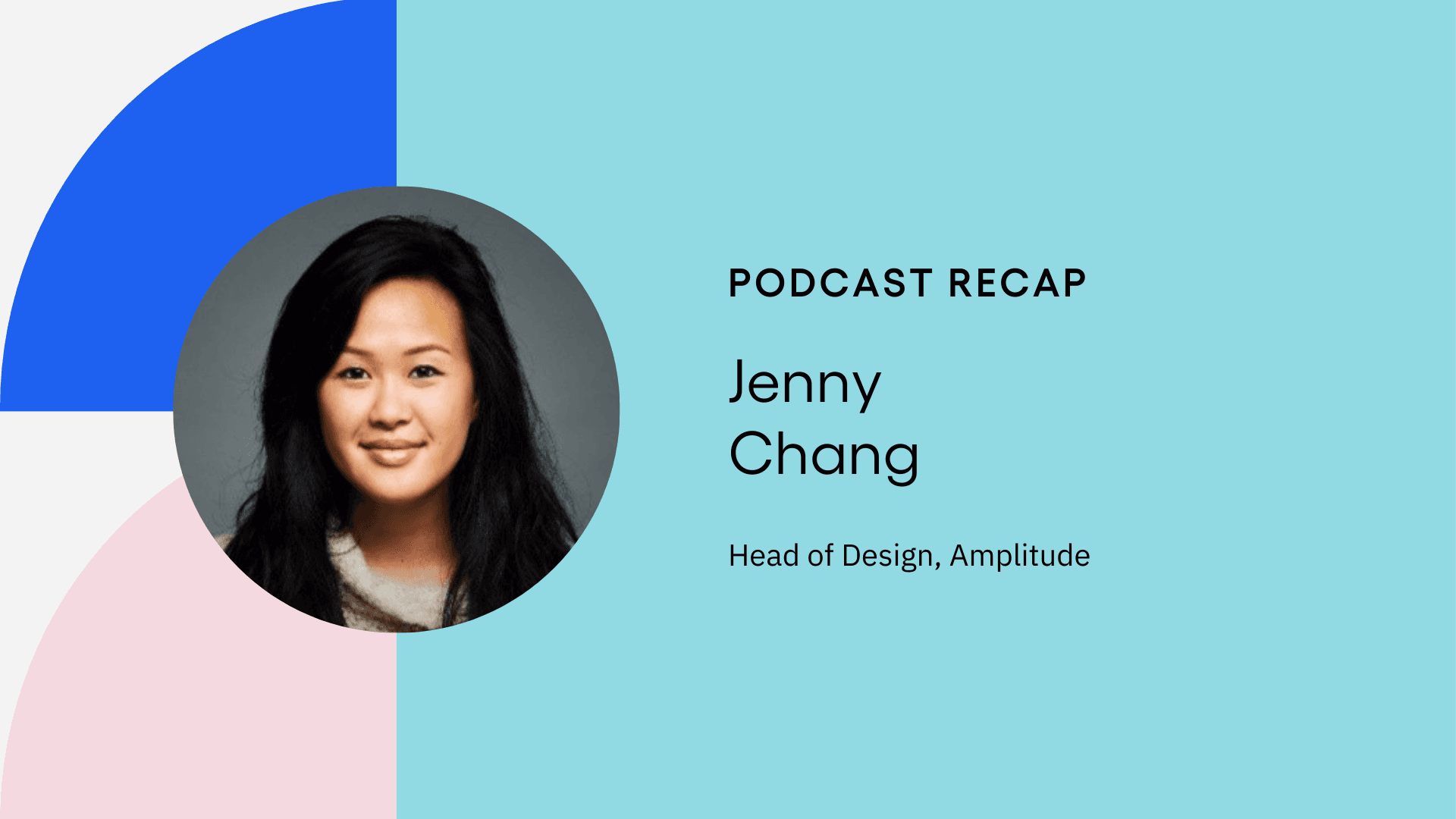
Today, the convergence of design and data-driven approaches has emerged as a pivotal force shaping product development and user experiences. In a recent conversation on Growthmates Podcast with Kate Syuma, Jenny Chang, Head of Design at Amplitude, provides a unique perspective on career growth and the integration of data into design practices. In this conversation, Jenny shares insights on:
- The journey from individual contributor to team leader
- Key motivations, principles, and challenges in transitioning roles
- Maintaining well-being in a managerial role
- The challenges between stakeholders and data teams
- Leveraging design processes for more effective collaboration
- The evolving conversation on data consumption at different levels
- Exploring ways to make “tracktion” meetings more engaging
Let’s dive into the conversation with Jenny where she unfolds her mindset shifts while growing at Amplitude for almost 7 years, becoming a leader and building a data-informed culture.
Tell us about yourself and elaborate on what factors, beyond culture, have contributed to your fast growth at Amplitude? What has consistently motivated you year after year in your professional journey?
I started at Amplitude as a UX designer and have held many titles over the years. Most recently, I stepped into the role of interim Head of Design. I have had a coach I've been working with over the last couple of years, and we've workshopped by identifying the principles and values I hold dear.
The key questions were: Does this job still align with those principles? Does this environment, does this community still provide what I value?
Jenny Chang
And I distilled it down. I believe this differs for many people, but personally, I prioritize community first and foremost. I cherish not only my friends at work but also the network, the knowledge, and the shared relationships. Building trust from scratch is challenging, so I am reluctant to give up the trust I've built with my colleagues on a day-to-day basis.
This realization was enlightening for me, and another essential factor is novelty. Initially considering it in terms of learning, I realized it's more than just acquiring skills or being taught something new. It's about embracing newness in every aspect — novel products, innovative processes, and the company's appetite for new ideas and conversations.
At Amplitude, I've never experienced a shortage of novelty here. It has been a thoroughly enjoyable journey.
The other aspect that motivates me is data. However, I don't want data to be a principle like in other companies. I view it more as evidence-based decision-making. It extends beyond product analytics to include research and grounded principles, providing concrete foundations for informed decisions.
You've traversed a considerable journey, and I'm eager to delve into the less glamorous aspects of that experience — specifically, the challenges. Would you be willing to share the challenges you encountered during your transition from an individual contributor to a manager?
In all the different phases of my career at Amplitude, I want to give huge kudos to all the leadership at Amplitude who supported me. I could not have done it without the managers I've had along the way and the leadership who saw something special within me and empowered me to be who I am today.
And I don't think it's just my perseverance alone. I think career progression also depends on the support network. That being said, I want to talk about the hardest transition I've ever made: the first shift from IC to manager. Fun fact, I refused to be a manager for a very long time. I love designing, I love creating things. I thought, holding people's psychological safety, I could inflict so much pain or self-confidence issues if I do this wrong. I'm not going to do this unless I take it seriously. My first transition took a really long time. It took someone else to tell me that I needed to do this. While in the role, it was really self-sacrificial. I wanted high-quality experiences while trying to manage the first two people, which started with one person, then two people, and then when it became four people, and I was delivering.
That was when I had another tough conversation. This is why I think trust is so important. My PM said, "Jenny, those designs are terrible. You are a great manager, and I think you need to come to terms with your prioritization, not only in this work stream but also in your life." I took that, and that was when I made the formal, official shift into managerial duties. I just think that being a manager is so dangerous if done incorrectly. The shift from IC to manager was to realize there is so much greatness if you dedicate yourself fully to being a manager. Seeing my team succeed is ten times as rewarding as anything I did as an IC.
Dive into full episode to hear Kate’s perspective while she transitioned from IC to Manager at Miro.
Could you share what supported you along the way, especially considering the potential roller coaster chapters in this transition? It seems like you've put in effort to maintain your well-being at a high level.
I'm thrilled you mentioned well-being because that's an aspect that becomes crucial in this journey. It becomes apparent that the prioritization exercise inevitably leads to tasks where one might not perform as well. This realization was challenging for me as I strive for quality in everything I do. I hold the principle of showing up as a full person, being intentional, and creating meaningful artifacts. I want my conversations to be impactful and drive progress.
Some compromises were inevitable with increasing responsibilities, including managing people and pushing forward projects. I took that burden upon myself — the consequence was a halt in my workout routine, poor dietary habits, late-night work sessions, and constant thoughts about work during downtime.
There came a breaking point where I realized that continuing on this path would negatively impact the outcomes I wanted to achieve, as well as my overall happiness and well-being. Since then, I've shifted my focus and become somewhat nerdy about well-being, delving into podcasts about nutrition, workout routines, sleep cycles, and body optimizations.
This realization is prevalent in the tech community because many experience similar challenges. Understanding the importance of the sequence of workouts and nutrition for maintaining sharpness and presence in conversations became clear. Now, my health is my number one priority, and my career comes second. Interestingly, making this prioritization shift has proven better for my career.
Shifting focus from career growth, let's explore Amplitude's unique approach to data-informed product and design work. While Amplitude is renowned for evangelizing data and fostering product-led growth, a common stereotype lingers—that data is exclusive to analysts. In your view, who should actively leverage data and analytics in their work?
I feel so strongly that data is for everyone. However, becoming data-informed and data-driven isn't easy, a lesson I learn with every new team member. It surprises people when I highlight the most challenging aspect—many are hesitant to engage with the tools or even get started. In my opinion, the easiest step is just asking intuitive questions, like in our user research calls or focus groups.
People often have excellent queries about their product, such as identifying frequent user groups or assessing the impact of recent changes. However, the challenge arises in translating these questions into actionable insights. The first step is understanding how to connect those questions to the existing data in your system or, if using an auto-tracking tool, recognizing the labels or tags applied.
Creating a chart based on these insights might seem like the end, but it's when the data team steps in to ensure accuracy. Sometimes, demoralization sets in when discrepancies are identified, and individuals might think it's too hard or that the data team has all the answers. It's a common journey, but the initial step—realizing that all those questions are data—is often misunderstood in the market. The real challenge lies in ensuring the accuracy of conclusions drawn from the data.
Have you witnessed examples of successful collaboration between stakeholders and data teams? Are there any rituals or best practices you've observed or would like to share to foster effective collaboration between these two crucial groups?
We've learned from our customers and what we're building that leveraging design processes into data processes can be quite effective. There are two notable approaches:
- The first is a rigid and militant design culture that precisely defines what can be shipped in the product, leading to accurate and aesthetically pleasing results. Similarly, data teams benefit from locking down exact events and segments within a system.
- The second approach where my preference lies is a collaborative design culture. In this approach, teams host design reviews, showcasing the evolution of a design—from wireframe to mid-fidelity to high-fidelity. They involve experts and stakeholders, fostering an interactive and inclusive environment. Workshops, brainstorming sessions, and iterative feedback from various contributors shape the final product.
In essence, creating an analysis isn't vastly different from designing. It involves teamwork, captures business objectives, and requires iterations for accuracy and beauty. Collaborative design teams make the process less intimidating, encouraging individuals to make their first chart and providing guidance on aligning with the audience's needs. Democratizing data relies on a human-centric approach, making processes like office hours and workshopping essential for a more inclusive and approachable data culture.
Are designers at Amplitude actively engaged in understanding why certain initiatives may not succeed or how things progress post-launch? How does data contribute to fostering shared responsibility within the team, connecting individuals more deeply to the insights and metrics?
We have established rituals to ensure thorough communication, visibility, and interaction with the insights and charts we generate:
- Each team participates in a metrics tracker meeting where leaders discuss metrics across various ongoing initiatives.
- Additionally, PMs, designers, and engineers conduct their own review processes, recently emphasizing revitalizing our designer reviews.
- Every business unit holds regular weekly check-ins, maintaining the same format as designer reviews or team meetings. The scale of these meetings influences their dynamics, with larger gatherings feeling more performative and intimidating while smaller groups create a safer, more casual atmosphere.
- Rather than a top-down approach, we appreciate the beauty in bottom-up conversations. Here, teams delve into data, asking questions like who clicked on a specific feature, their actions in the product, and similarities with other users. These discussions act as a unifying force, bringing the team together around the insights and making data a glue that binds us collaboratively.
Could you share your perspective on how leaders at a high level should consume and stay updated with data? What strategies or practices are in place at Amplitude to support this level of data consumption among leadership?
It's an ongoing conversation at Amplitude, and we've experienced shifts in how we approach data at leadership levels. Our CPO emphasizes the importance of setting objectives before key results (OKR), ensuring a clear understanding of goals before measurement. We've learned from cycles where we unintentionally became too focused on key results (KROs), which can be precarious.
Leadership's value in data lies in understanding it as the heartbeat of everything we create—it's the pulse of new initiatives. However, it's not a straightforward correlation, especially in technical areas like data management. For instance, measuring activity in data management highlighted the need to distinguish between fixing broken data and creating insightful charts. The ongoing dialogue at the leadership level revolves around finding the most accurate way to measure the baseline of our product's heartbeat. We strive for transparency in our data meetings, avoiding performative discussions and encouraging honest assessments, including concerns and areas for improvement. The TLDR is that our leadership conversations are dynamic and focused on genuine insights rather than just hitting metrics.
Have you come across examples, either from customers or internally, where such meetings were genuinely captivating?
Certainly. To address the question about making these meetings engaging, we've been working on incorporating a Session Replay product within the Amplitude platform. Visualizing a user's journey alongside the data adds a new dimension, offering insights that traditional charts might miss. We drew inspiration from tools combining product analytics with session replays. The idea is to bring up user interactions that correlate with the presented data in real time. While we're still refining the integration process, teams internally have found it valuable, making discussions more interactive and actionable. Additionally, efforts are underway at the product operations level to enhance engagement by sharing wins and accomplishments, creating a more dynamic and rewarding meeting environment.
Listen to the full conversation with Jenny on Growthmates podcast: Apple | Spotify | YouTube and Subscribe to get new episodes.

Kate Syuma
Founder, Growthmates, ex-Miro Head of Growth Product Design
Kate is a growth advisor on the intersection of PLG and UX and ex-Miro head of growth product design. She was part of the founding Miro growth team. Kate is the founder of Growthmates — the place to connect with growth, design, and product leaders.
More from Kate


