Get to Know Amplitude’s New Always-On Data Analysts
AI agents are eliminating the biggest bottleneck in product analytics — the gap between insight and action.

Most analytics tools give you a faster way to answer the same old questions. We think that's the wrong problem to solve.
The real bottleneck isn't how quickly you can build a chart. It's everything that happens before and after: the questions you didn't think to ask, the session replays you never had time to watch, the insight that sat in a dashboard all week while your team shipped the wrong thing.
That's what we built Amplitude AI Agents to fix. Not a smarter query tool, a system that does the analytical work for you, surfaces what matters before you go looking, and takes action on your behalf. It runs while you're in meetings, while you're sleeping, while you're doing the work that actually requires a human.
We just launched three capabilities that change how your team interacts with data: the Global Agent, Specialized Agents, and Amplitude MCP. Because they’re so new, we also hosted a webinar with the expert team that built them, giving anyone an up-close look at what they do and why they're different. Here’s an overview of the capabilities (and the new workflows they enable) you’ll see during the webinar.
Global Agent is the new face of Amplitude
Our new Global Agent is the new primary conversational interface inside Amplitude. This changes how you'll interact with your data going forward—no more static charts or complicated menus.
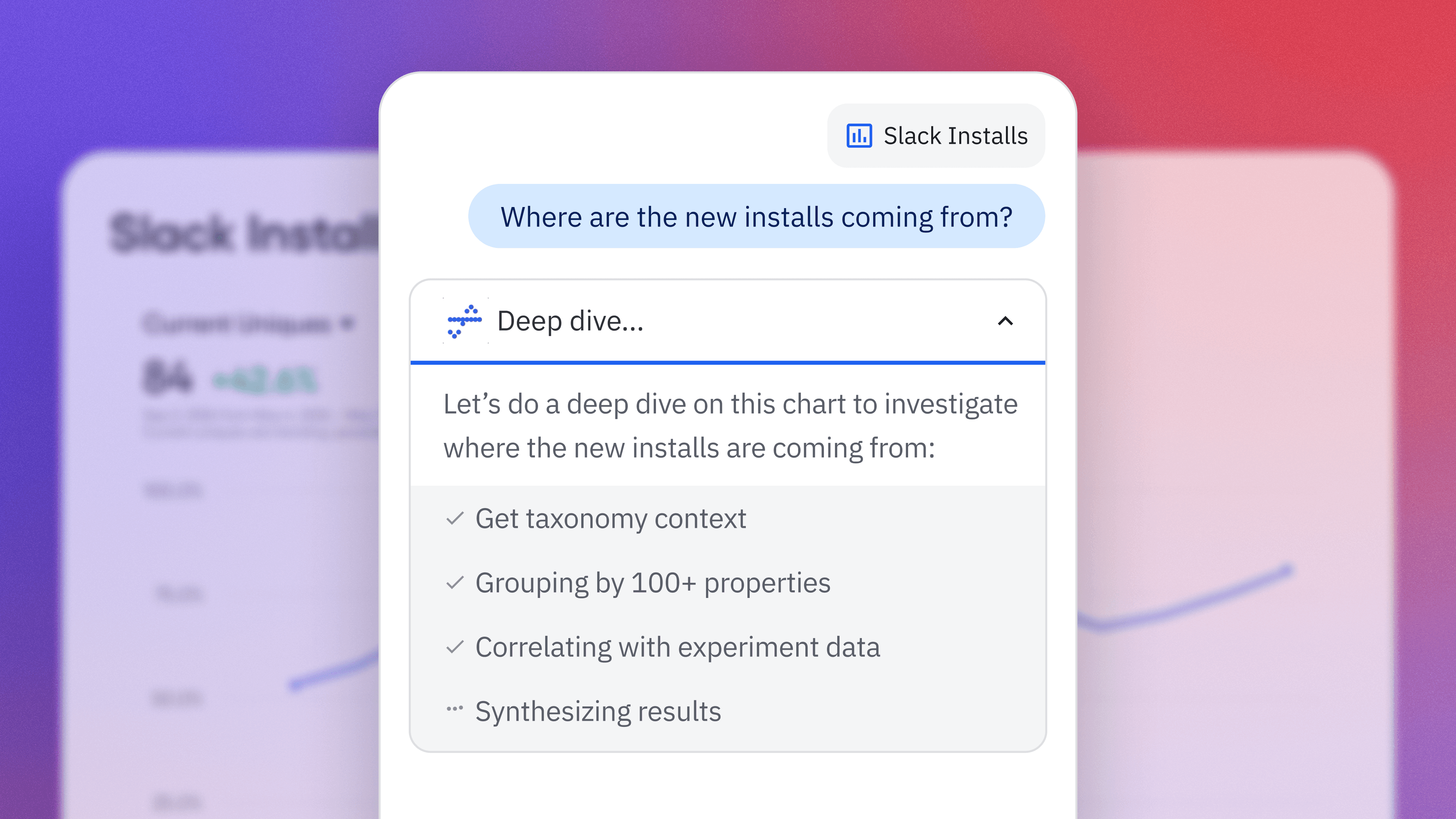
You talk to Global Agent in plain language, just like you’d chat with an analyst. Ask it something like "How's our onboarding flow performing?" and it dives deeper than just a single chart. It searches your existing content first—dashboards, notebooks, session replays, AI feedback—to understand a complete picture. If it can't find an existing answer, it builds new analysis on the spot. You get streaming insights, substantiated by a live dashboard you can explore further.
What makes it powerful is how it handles ambiguity. Our team spent months refining evaluations specifically around messy, real-world questions—the kind people actually ask, not the clean, well-structured queries you'd type into a search bar. The result is an agent that understands your intent without making you fill out a questionnaire first.
In a single conversation thread, you can:
- Break down any chart by plan type, geography, or custom properties—without knowing your event taxonomy
- Create behavioral cohorts of users who did (or didn't) take a specific action
- Draft and deploy in-app guides to those cohorts
- Identify power users for research and generate personalized outreach emails
- Build comprehensive dashboards with dozens of charts across multiple sections—in minutes, not hours
Global Agent is also available in Slack, so you can kick off analyses between meetings and get results wherever you're already working.
Always-on agents that work while you sleep
The Global Agent is your on-demand expert. Specialized agents are your always-on team.
Think of them as purpose-built analysts assigned to specific tasks—watching your funnels, reviewing session replays, analyzing customer feedback, and monitoring dashboards. They run in the background, find what matters, and push insights to you before you think to ask.
The specialized agents available at launch include:
- Dashboard agents: Monitor your high-traffic dashboards and surface changes automatically
- Session replay agents: Analyze hundreds of replays, extract behavioral patterns (rage clicks, dead clicks, navigation issues, JavaScript errors), and deliver highlight clips tied to each insight
- Customer feedback agents: Pull themes from surveys, support tickets, Slack mentions, and other feedback sources
- Web conversion agents: Identify dropoff opportunities across key conversion flows
Every insight comes with recommended next steps. And because these agents push to Slack, your whole team gets the analysis without anyone having to go looking for it.
One of our team's favorite quotes from an early customer: "I go into every Monday morning feeling like the smartest person in the room without any work."
Amplitude data, everywhere you already work
The third capability is Amplitude MCP—a connection layer that brings all the behavioral context inside Amplitude into the external AI tools your team already uses: Claude, Cursor, ChatGPT, Figma, Notion, and more.
Using MCP, you can point Claude at your Amplitude data and ask it to analyze customer feedback, surface trends across feedback channels, or pull session replay insights—all from a single prompt. The agent navigates your projects, identifies the right data sources, and synthesizes findings without you having to specify where to look.
The ceiling on what's possible just got a lot higher. Engineers can take an insight from Claude and drop it directly into Cursor to ship a fix. PMs can pull a recommendation and kick off an experiment from the same workflow. The data lives in Amplitude; the action happens wherever your team works best.
How it’s built
Here are a few things worth knowing about the architecture and philosophy behind these agents:
Context is everything. Every agent starts by assembling context before it does anything—your system prompt, organization-level business context, project-level data descriptions, page context, chat history, and any files you've uploaded (product strategy docs, data dictionaries, etc.). The more context you give the system, the better the output. There's a hierarchy: company level, project level, agent level. All of it works together.
Amplitude is a semantic layer. One of the things that makes Amplitude well-positioned to build agents that truly understand your data is that the platform itself is a giant semantic model. Event names, chart titles, experiment results, session replays, AI feedback—all of it carries meaning about how your product actually works. That semantic foundation is what lets agents answer not just "what happened?" but "why did it happen?” and “what should we do about it?"
Multiple models, one orchestration layer. Different agents use different models from OpenAI, Anthropic, and Google, coordinated through Amplitude's internal orchestration layer. Model capability has improved dramatically over the past year—the team has rewritten significant parts of the system as new models made previously difficult tasks straightforward.
No training on your data. Amplitude has zero data retention agreements with major model providers and a strict no-training policy. Your data is not used to train external models.
It’s free. All of this is a native part of the Amplitude platform—no usage-based add-ons, no contract upgrades required. The reasoning is simple: the more your team uses AI to ask questions and make decisions, the more value they get from Amplitude.
What this means for your team
A few patterns are already emerging from early users.
Teams are running more analyses than they used to—not because they have more time, but because the cost of asking a question has dropped to nearly zero. Questions that used to require an analyst ticket now get answered in seconds.
Recurring reporting is getting fully automated. Weekly dashboard readouts, session replay summaries, experiment check-ins—all of it lands in Slack on a schedule, without anyone having to build or send it.
And the insight-to-action loop is getting tighter. An agent surfaces a bug pattern in session replays. That finding goes to Slack. An engineer opens it in Cursor and ships a fix the same day. A PM uses the same insight to kick off an experiment. The whole cycle—from observation to action—happens in hours instead of weeks.
The work that used to fall between the cracks because no one had time for it is getting done automatically.
Want to see all of this in action? Watch the full launch session to see live demos of Global Agent, Specialized Agents, and Amplitude MCP—including a real look at how the system works under the hood. Watch the full session now.

Nikhil Gangaraju
Director, Product Marketing, Amplitude
Nikhil is a product marketer at Amplitude focusing on Amplitude Analytics and works with teams to advance our mission to help companies build better products.
More from NikhilRecommended Reading

Amplitude Plug and Play: New AI Plugin in Claude and Cursor Marketplaces
May 1, 2026
5 min read

Introducing Amplitude Wizard CLI: Set Up Amplitude from Your Codebase
Apr 30, 2026
6 min read

Making AI Search Count (and Convert)
Apr 29, 2026
4 min read

How VEED Evolved Its AI Search Strategy
Apr 29, 2026
3 min read