3 Steps to Get Your Product Flywheel in Motion
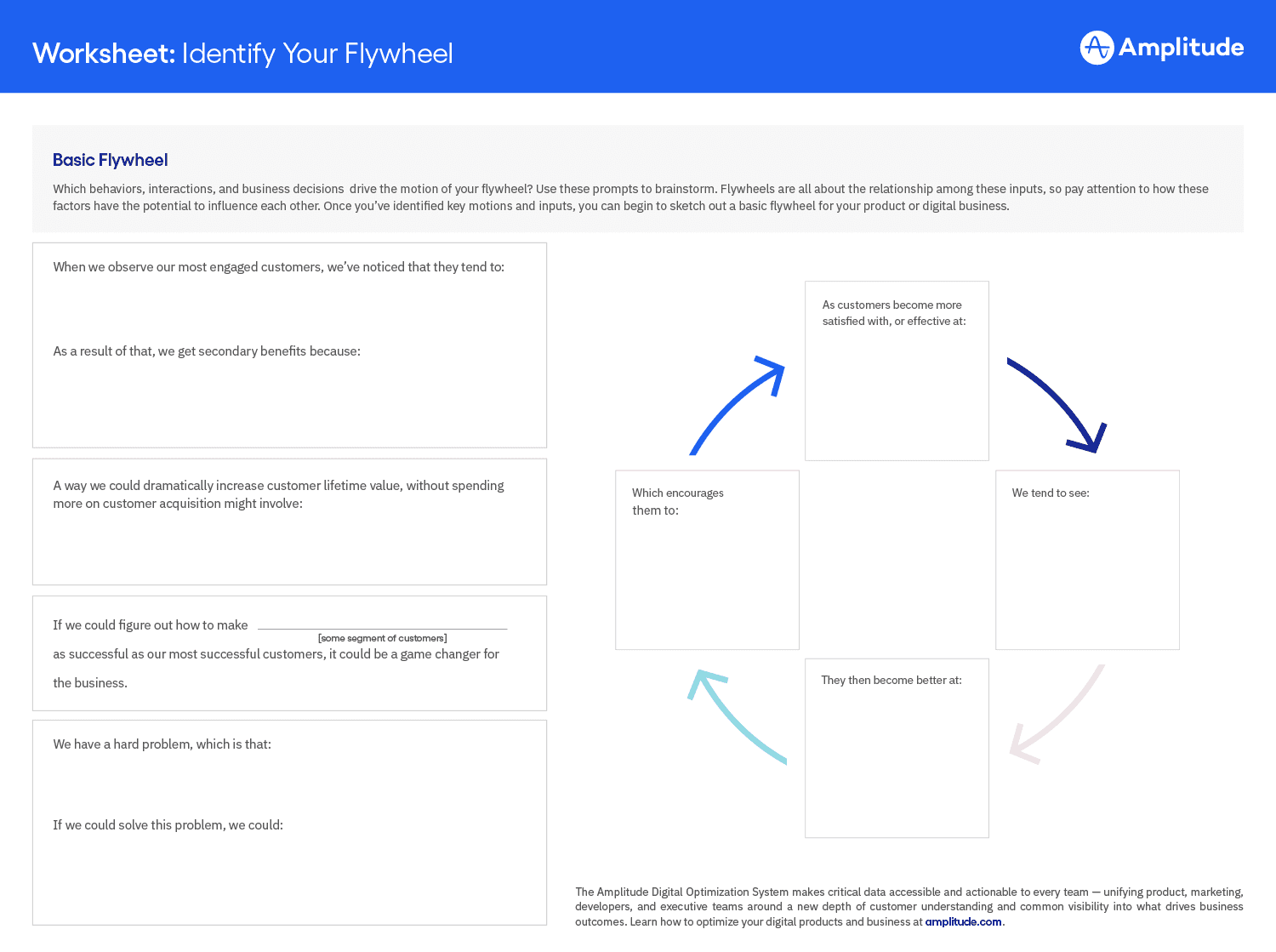
Use the example diagrams and worksheets—from the new Flywheels Playbook—to identify your product's flywheel and find ways to accelerate it.


The only reason pole vaulters can jump over the bar is because of momentum. Although they possess the pole—the thing that launches them up and over—it’s useless without the proper inertia or force.
The world of business is quite similar. Companies may have the correct tools to accomplish their goals, but if they don’t understand how to generate momentum, they may never reach the bar (much less get over it).
Flywheels are used as a concept to help businesses frame the components that help them function. By identifying the aspects of their business that generate momentum, they can focus on those mechanisms to create more growth.
Just like a mechanical flywheel, if you apply force, it will keep spinning on its own. Apply more force, and the flywheel will spin faster. Almost every business already has some kind of flywheel structure built into it. The challenge is learning how to turn it.
1. Identify The Components of Your Flywheel
As we note in The Product Strategy Playbook: A Guide to Flywheels,
The idea of a product or experience flywheel is to identify where and how you can trigger virtuous loops. In other words, flywheels are the collection of variables, levers, and interactions driving your business growth. These loops or flywheels can then provide a hypothesis for how different components of your product can take more precise aim at your North Star.
As an example, let’s assume you’re the owner of a coffee chain, and your customers can use a mobile app to earn points. Your virtuous loop might look something like this:
Example B2C Product Flywheel
Each component of the flywheel fuels the next, and together, they generate a cycle of momentum that keeps your business running. There’s no foolproof way to discover the components of your flywheel because every business is inherently different.
In The Product Strategy Playbook, we explore flywheels in five different industries: B2C/consumer tech, B2B/SaaS, media, fintech, and ecommerce. Every business segment includes its own native challenges and opportunities, but there are common principles embedded in each one’s flywheel.
- Identify and communicate value: Successful flywheels need a virtuous cycle of business value providing customer value and customer value leading back to business value. Once businesses know what problems they solve for customers, then they can push their flywheel by further addressing and communicating that value.
- Prioritize customer satisfaction: Some flywheels will attract more velocity through word-of-mouth, customer loyalty, and retention. These are the fruits of satisfied customers who acknowledge the value offered by a business and keep coming back for more.
- Continuous learning is key: Any product team needs to balance “learning” and “doing” in tandem so that customer insights are regularly leveraged to improve the digital experience. To keep the flywheel turning, make sure your team seeks to understand which motions drive customers to the next motion in the flywheel.
To learn more, download the Product Strategy Playbook: A Guide to Flywheels. The playbook details specific examples of virtuous loops. Inside you’ll find three worksheets to help you identify your product’s flywheel and develop a supporting strategy.
2. Use Product Analytics to Find What’s Working and Accelerate It
Once you’ve determined your virtuous loops, you can use product analytics to discover the role each one plays in your flywheel. Since flywheels and their virtuous loops should be viewed as a hypothesis, you can use data to confirm your ideas about what’s working and what’s not.
To illustrate how to optimize loops with analytics, let’s return to our coffee chain example, which can also be found in our Flywheels Playbook.
By collecting first-party customer data from your mobile app, you can accelerate certain components of your flywheel. This information will tell you where customers find value, how they’re using the app, and how you can improve your product.
- Customers download the app: When customers come into your store for the first time, perhaps they get a discount for downloading your app. Here, you might incentivize downloads by offering a discount on your most popular items, only available via the app. Once you’ve generated enough data, you can find out which items encourage more downloads and make any changes.
- Customers earn points: When customers make purchases, they earn points in the app. Here, try shifting the point values based on the items customers are buying. Through experimentation and testing, you might be able to fuel this motion by changing the point values based on customer behaviors and preferences.
- Customers use points to purchase rewards: If you see that customers are constantly using their points to get certain items, you might feed this motion by lowering the number of points needed to get those desired items. Additionally, you can track customer behaviors around how long they go without spending points or how likely they are to return to your store when they have a specific number of points.
- Customers become loyal to the app: Once customers download and use the app regularly, you can feed this motion by using the app as a communication tool. Use notifications to announce new items or discounts or allow customers to share their points with other users.
The beauty of identifying what fuels loops with product analytics isn’t just accelerating each one. Behavioral data also reveals how different components are connected to one another—like app downloads feeding into point-based purchases. Once you see these connections, you can adjust your product experience to propel these loops further and create more momentum.
3. Minimize Friction Throughout the Flywheel
Accelerating the flywheel is only half the battle. You also need to identify friction points that slow down your loops. The best way to locate friction points along the customer journey is through product analytics. User behavioral data will help you spot issues, like a sharp drop in engagement in your app or underperforming marketing campaigns. Once you understand what your customers are actually doing, you can make changes and pay attention to the results.
Download this worksheet to identify common friction points in your flywheel.
Maybe your coffee chain’s loyalty app was having issues with activation. After looking at your user behavioral data, you notice that the discount incentive is driving app downloads, but too many customers abandon the app once they try to log in. By making account activation easier, more customers will likely enter the app and start cashing in those points.
NBCUniversal propelled its flywheel by making its content more relevant to visitors. Based on its A/B test results, NBC improved its Vizio TV experience and tailored its app homepage based on user history. Amplitude’s behavioral cohorts enabled it to target audience segments and offer content based on user data. These actions ultimately increased retention and overall viewership.
Happy Customers Drive Product Flywheels
Your flywheel will gain more momentum if you keep your customer’s satisfaction at the center. Their happiness and continuous business are what enable you to sustain growth while pursuing product improvement.
When thinking about ways to accelerate your flywheel, don’t get too lost in the data. Zoom out and remember that your end goal is providing value to your customers.
For more guidance on how to identify your product flywheel and keep it spinning, download the Flywheels Playbook today.


Mallory Busch
Former Senior Content Marketing Manager, Amplitude
Mallory Busch formerly ran the Amplitude blog, frequently named a best blog for product managers. She also created AmpliTour, the live workshop for beginners to product analytics and 6 Clicks, the Amplitude video series. She produced the Flywheels Playbook, wrote The Product Report 2021 and produced The Product Report 2022. A former developer and journalist, Mallory's written work and coding projects have been published by TIME, Chicago Tribune, and The Texas Tribune. She graduated from Northwestern University.
More from Mallory


