Building Your Startup Dream Team: Key Roles and Hiring Strategies
Learn how to develop your startup's most valuable asset—its team.


At early-stage startups, every hire counts. To hire a small team that can drive growth quickly, knowing the key traits to look for and focusing your hiring on the areas with the most immediate impact is essential.
I joined Remote in 2020 when the team was only around 20 people. Since then, we’ve grown to over 1,400 people, revolutionizing remote employment with our global HR platform. In this post, I'll share lessons from my experience during the early days of Remote to help you build your startup dream team.
- Look for team members who prioritize impactful outcomes over busy work, can achieve goals with limited resources, and are comfortable in a growth-oriented environment.
- Small teams also require strong interpersonal skills, so hire individuals who can collaborate and build relationships.
- Initial hires should extend the founders’ strengths to establish an early competitive advantage.
- Prioritize hiring in product development, engineering, marketing, and sales.
- Adopt tools enabling you to hire the best talent and build a world-class product.
Identify startup-savvy talent
Many highly skilled and wildly talented people are not suited to the startup environment. When hiring, look for people with traits compatible with a fast-moving, growth-focused environment who gel with the existing team.
Versatility
At a startup, you don’t have the luxury of delegation. There’s no room for people who can build visions, strategies, and plans without being able to execute them. You want to find people who aren’t afraid to get their hands dirty or work in areas that might fall outside their specialty.
In the early days of Remote, our DevOps leader was also our tech ops person who helped make sure our laptops worked correctly. Our product designers also worked on our website. Our VP of growth, Elisa—an incredible strategic leader—spent some of her time on tasks usually delegated to a junior-level employee, like writing copy and handling login issues.
This kind of startup environment might be a shock to the system for people who have only ever worked in large organizations with strictly defined role responsibilities. Your ideal team cannot simply set the strategy but must also be able to do the grunt work that pushes that strategy forward.
Efficiency
A startup team needs to be able to execute and achieve outcomes quickly. When hiring, look for people who prioritize outcomes delivered over hours worked and can operate autonomously.
Working independently is especially important in a remote team that stretches across multiple time zones. In the early days, most of our team was in Europe, while I lived in Texas. I had to be disciplined and productive during my afternoons, when most people weren’t online, to keep projects moving forward while others were already out for the day.
Collaboration
When I started at Remote, I knew and collaborated with everyone, even engineers I normally wouldn’t interact with on a larger team. Startup teams are small, so it’s crucial to develop a one-to-one connection with everyone in the organization. Aim to hire people who can work collaboratively, navigate relationships across an organization, and share a united vision.
Complementary skill sets
When hiring in a large company with established processes, you’re typically looking to add to the functions that the company already has. At the beginning of a startup, you instead want to build around the founders’ areas of expertise. Focusing on these core competencies enables you to establish your competitive advantage early on. Later, as you grow, you’ll hire for more functions outside the founders’ wheelhouses.
The Remote founders, former VP of product at GitLab and VP of engineering at Unbabel, had strong backgrounds in product and engineering. The first hires at the company reflected that background: product engineers and designers who spent the company’s early days focused on building a high-quality product. Once the product was in a strong place, they started to hire an international expansion team and marketing folks.
Feedback from investors can also help you identify gaps in expertise where you need to hire. I was Remote’s first marketing hire under our VP of growth. The team brought me on because they’d heard from investors that because of the sensitivity of the space—handling employee data, payroll, taxes, and compliance—building trust was essential. We needed content to showcase our expertise and gain that trust, so I became the content hire to meet that need.
Focus hiring on four key areas
Though the bulk of your hiring will focus on filling gaps and complementing strengths, almost every startup needs great talent in these four core competencies:
1. Product Development
A successful product starts with a strong product development team:
- A product manager is responsible for defining the product roadmap and coordinating designers and engineers
- A product designer in charge of creating a seamless user experience
Given the technical expertise of the Remote founders, we didn’t initially have a product manager—our CEO led product. But if you’re a CEO without a technical background, you need someone to lead the technical vision.
A strong product manager will work with designers and developers to set realistic expectations for the amount of work the team can produce. They’ll have a strong understanding of customer needs and iterate the product quickly to meet them. The best product managers are data-driven: They know which metrics to pay attention to and run experiments to move those metrics in the right direction.
Product managers at successful startups use Amplitude’s Digital Analytics Platform to help them cut out the noise and act on reliable, real-time data.
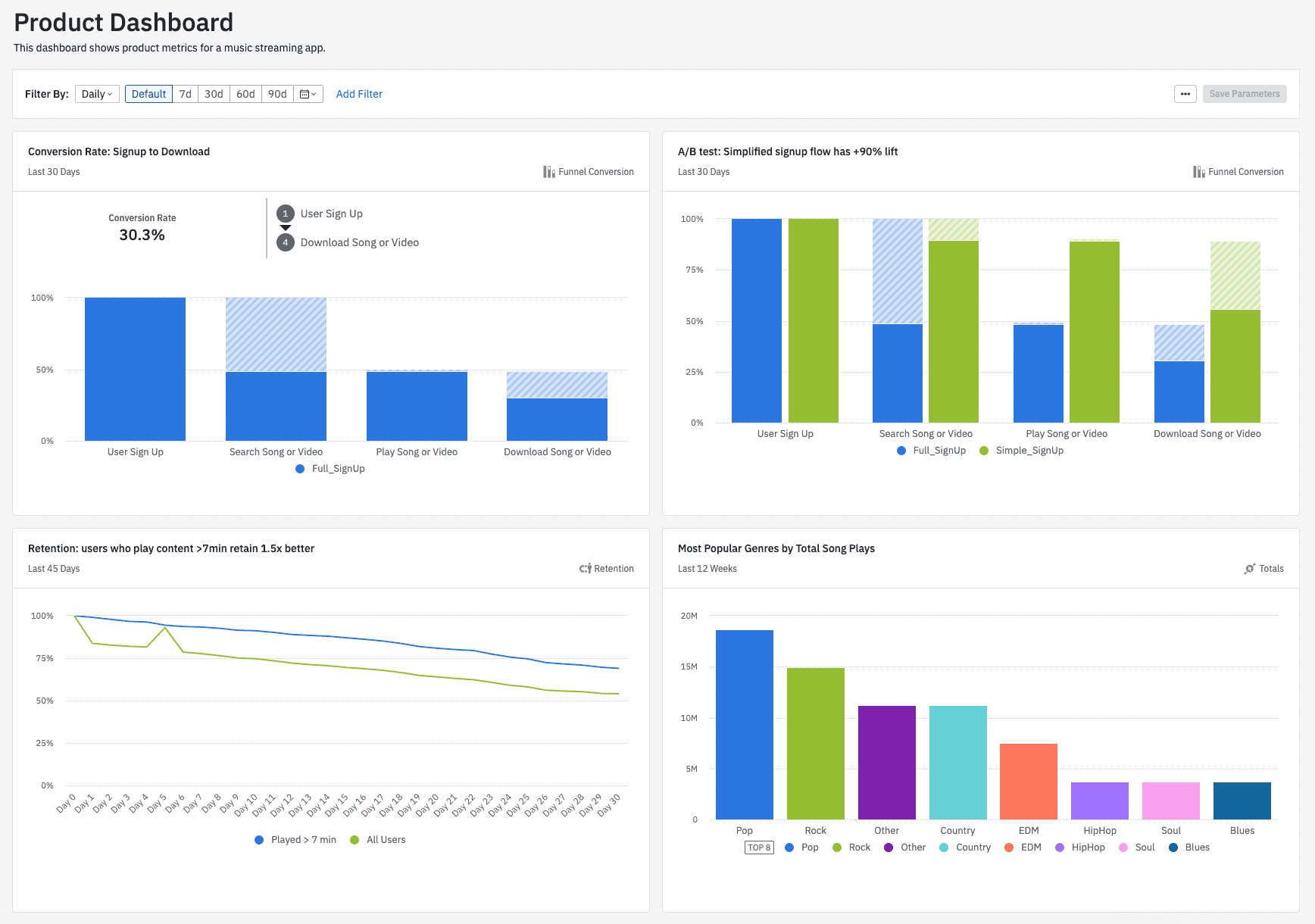
An example product analytics dashboard in Amplitude
It’s vital that early product designers set the company up for scale by building a product design system. The system should work immediately and last a year or two—as you add other designers, they can slot into the system.
2. Engineering
A solid engineering team is essential for building and scaling your product. Early on, consider hiring:
- A chief technology officer (CTO) to oversee the company’s technical direction
- A DevOps engineer to maintain smooth deployment and operation of the product
- Front and backend developers to build and maintain the product
The startup environment requires a technical leader in a senior position to lead the technical vision of the company, uniting engineers with the product team. That person will work quickly while preparing for scale. While it’s tempting to write some spaghetti code with the intention of coming back to fix it later, it’s better to lay a solid base you can build on as you grow.
At the initial stage, don’t hire junior developers outside of rare edge cases. You don’t have much time for training and teaching people. You want experienced professionals who can work autonomously and complete projects on their own.
One of the main selling points of our company is our product. The Remote platform is extremely mature and works well today, thanks in no small part to the technical capabilities of the initial team. The engineering leadership and our robust team of engineers were aligned on their vision for the product and fully immersed in the technology.
3. Marketing
Marketing is necessary for reaching and engaging your target audience. Key positions to hire include:
- A head of growth to devise and implement strategies for user acquisition, retention, and monetization
- A performance marketer to run experiments and campaigns designed to rapidly expand the user base
- A content marketer who creates content to draw and engage audiences across platforms
A strong head of growth will define the product’s ideal customer profiles and build an acquisition strategy. They’ll test out different acquisition channels and double down on the channels that lead to conversion and retention.
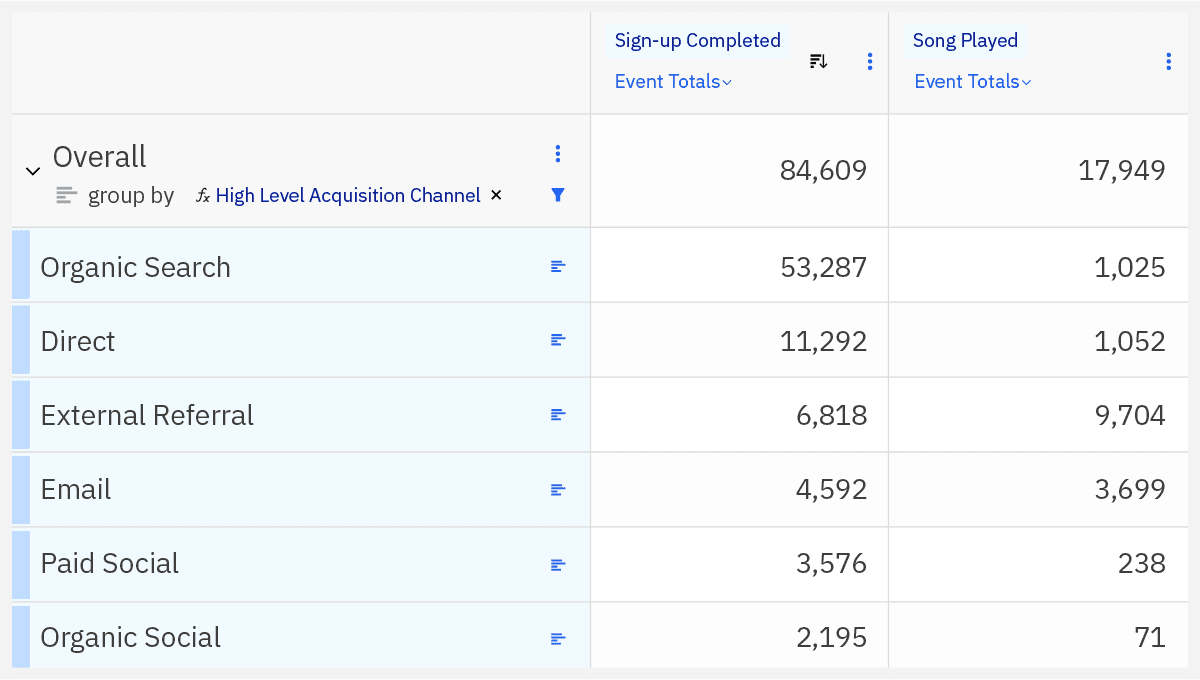
Marketers use Amplitude channels to identify the best channels for acquiring active, engaged users
4. Sales
A strategic go-to-market team is essential for a successful product launch and gaining traction in the competitive market. You’ll ideally hire:
- A sales representative focused on new customer acquisition and revenue growth
- A customer success manager dedicated to fostering retention
- A business development manager tasked with identifying partnership opportunities to expand the company’s reach and revenue streams
In the early stages of B2B startups, customer success and sales representatives are closely tied. They both work as account executives to maintain and nurture a small number of customers. If the startup is for a B2C app, you might get several thousand users quickly, so you won’t have the same 1:1 relationships with early customers. However, you’ll still need someone directly responsible for customer feedback.
In any case, those hires are the ones who advocate for customer focus in the organization. They’ll also be adept at parsing customer feedback into:
- An urgent complaint to resolve
- A feature request to relay to the product team
- Expectation management with the customer
Startup sales are distinct from sales in a well-established organization. In most cases, you’ll be selling a minimal-viable version of a product to a niche audience. If you bring in someone used to selling full-featured products out of the box, they might not have that much success.
A startup salesperson will sell the vision and lean on the speed at which startups iterate. They’ll identify customers ready to grow with the company and the product as it improves over time.
Get the right tools to help you grow
No company wants to waste resources on software that doesn’t improve business outcomes. Select tools that help you achieve sustainable growth at scale.
Remote: Access the talent you need
Finding talented, highly versatile, efficient people whose skill sets complement your founders’ specialties, who can work well with your existing team, and who share your startup vision is not easy. And the chances are, those people aren’t based within a 50-mile radius of you.
International remote hiring enables you to access pools of talent that haven’t previously been available. Remote simplifies the global HR process so you can hire the right people for your organization, regardless of where they are in the world.
Attractive compensation is also essential to snag the best talent—which is tricky on a startup budget. While you may not have the cash flow to offer salaries that compete with more established companies, with Remote, you can offer stock options to employees in other countries, helping you to attract and retain international talent.
Learn more about how to run global HR like a local with Remote. Amplitude customers can receive a 20% discount with promo code PMAMPLIT20.
Amplitude: Accelerate your journey
The most successful startups win because they innovate and adapt faster than established competitors. They ship, analyze customer behavior, and then iterate their product. They don’t have time to wait for a data analyst to run an SQL query and get back to them in a few days.
Amplitude offers digital analytics and experimentation in one unified platform, giving startups easy access to the deep data insights they need to grow. Teams can uncover customer behavior, run experiments, and release or roll back features in a controlled way with feature flags. All that helps teams learn fast and drive growth.
To help startups on their journey to product-market fit, Amplitude offers the Scholarship Program: a temporary plan for startup customers, giving them access to one year of Amplitude at no cost. Learn more and apply for the Amplitude Scholarship Program.

Preston Wickersham
Manager, Content Marketing, Remote
Preston is the manager of content marketing at Remote, where he leads the development of knowledge materials on distributed workforces, international employment laws, and remote work insights. A native Texan, Preston has been a champion of remote work since 2014.
More from Preston


