5 Diagrams That Explain Product-led Growth (& Bonus Worksheet)
Product-led growth is all the rage these days. But what does it mean to be product-led? These examples provide an overview of PLG and show what product-led growth can look like for B2B and B2C companies.

Product led-growth (PLG) is a business model that relies on the product as the main driver for customer acquisition, engagement, retention, and expansion. A PLG business focuses more on creating great in-product experiences for its users as opposed to relying heavily on marketing and sales to earn paying customers.
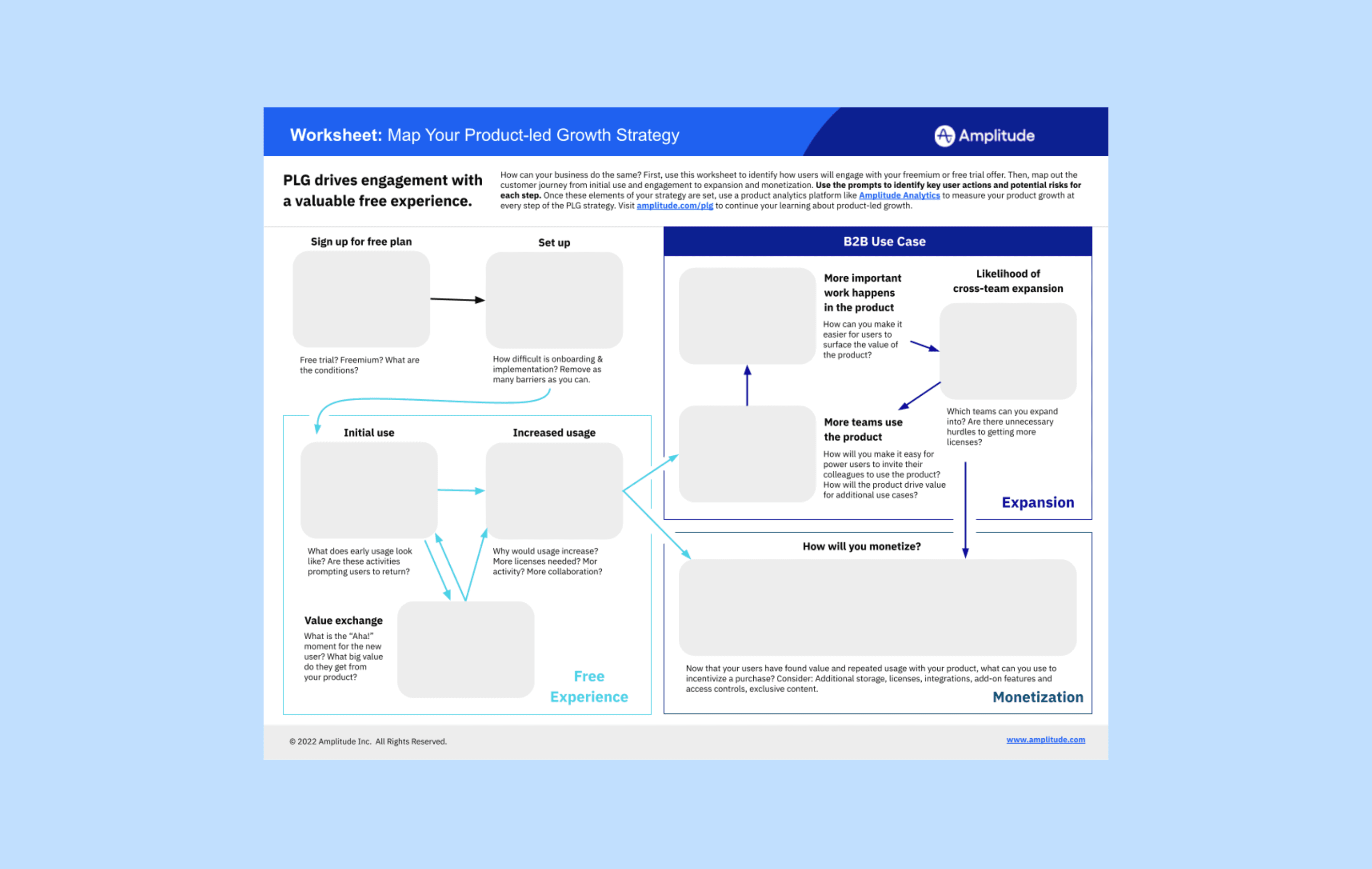
Map out your own PLG strategy with Amplitude’s free worksheet
Traditionally, brands try to show consumers that their product is valuable before giving them access to it. But giving more people access to your product through free trials and freemium plans lets the product speak for itself by giving immediate value to your users. That’s a core element of product-led businesses.
You’re improving your product experience rather than using sales and marketing to convince users that they’ll see value from something they haven’t seen firsthand.
Being product-led means:
- More conversions. Product qualified leads (PQLs), in other words, prospects who are using your product on a free plan or trial, earn a 5x higher conversion rate compared to the overall conversion rate (including PQLs, MQLs, and SQLs) according to OpenView.
- Accelerated growth. OpenView also reports that when PLG companies reach $10M in annual recurring revenue (ARR), they tend to scale at a faster rate than their peers.
- Lower customer acquisition cost (CAC): When the product sells itself, you don’t need to expand your sales team or increase your marketing budget as much to grow. Any investments in the product lead to ongoing increased conversion rates.
- Greater customer loyalty: Product-led growth capitalizes on strong customer relationships. Product development and improvements happen as a result of customer engagement data and feedback. Loyalty is stronger, and it happens almost automatically without human intervention. So business growth costs less, and it’s compounding.
PLG companies don’t do away with their marketing and sales teams completely. They still work in tandem with the product—and you can use their power more effectively.
With PLG, sales can focus on expansion deals that neeed a more personalized touch to scale up from freemium to paid, cross-departmental usage. And marketing can work on awareness efforts that bring new eyes to your product. By leading with your product’s value, though, much of the traditional sales and marketing process becomes automated. This is because:
End users are actively searching for and discovering your product.
- Users have a need, and your product fills it. They’re going to Google search or the App Store to find a product like yours.
- Here, it’s critical for the marketing team to drive awareness efforts, such as through paid ads or SEO content.
When users find your product, they immediately want to try it.
- By engaging with a free trial or freemium experience, end users avoid “the sales slowdown.” They can become active users of your product within hours of hearing about it for the first time.
Product-qualified leads (PQLs) are easier to convert into paid opportunities.
- Once a user experiences the value of your product, they’re likely to become internal advocates for expanding usage, whether by upgrading to paid tiers or expanding licenses (above a free limit) across the company.
- At this point, your sales team can get involved to bring these deals over the line, especially for large enterprise deals that need a more human touch.
- It’s also much more effective for the sales team to focus on deals with a higher chance of conversion—deals where there are already advocates inside the account—rather than to waste time cold calling or sorting through endless contacts who might be persuaded to try the product.
With a PLG strategy, every team wins. Your customer journey becomes more reliable and scalable.
The benefits of product-led growth are already clear, but what does that look like in practice? Use these five diagrams to visualize how it could work for your business.
Key takeaways
- Adopting a product-led growth model leads to a quicker payoff and compounding growth.
- Product-led growth is cyclical—so growth is fueled by great product experiences, word-of-mouth, direct discovery, and continued use.
- PLG lets your sales team give more attention to enterprise customers with longer sales cycles. You automate more of the customer journey for your SMB and mid-market customers, so your sales team can give a human touch to the multimillion-dollar deals that need it.
Diagram 1: Product-led growth means a better payoff in less time
Sales-led growth depends on a lot of upfront investments: building the sales team, developing sales collateral, investing time in lead qualification, and so on. And after you’ve made these initial investments, it takes time to see a return.
In this diagram by product coach John Cutler, the trade-offs between investing and receiving value from those investments over time are clear. In both a product-led and sales-led model, you must make investments. Within PLG though, you see more immediate outcomes. It’s not a straight line towards growth—you must still figure out how to drive activation, engagement, and loyalty with your product. But in the time spent doing this work to improve the product, you’ll already be seeing the benefits of customer acquisition. Whereas in a sales-led motion, you may only just be about to get paid users ramped up on the product in the same amount of time that they’d likely already become loyal advocates through PLG.
In a PLG model, the product is doing the work that your sales team might normally do through freemium products or free trials. In giving away part of the product for free, you let customers fall in love with it through firsthand experience.
Product-led growth requires minimal investment at the beginning—setting up the free or freemium plan and activating new users. You see it pay off right away as people start to use your product. Once users are set up, you’ll want to invest in product improvements that keep users engaged and build customer loyalty.
With each of these small investments, you see immediate payoff because users’ experiences improve right away. This also means you can make investments and improvements more frequently than a sales-led team.
Diagram 2: The B2B SaaS customer journey for product-led growth
It’s helpful to start by examining a typical B2B SaaS customer journey to gain an understanding of how product-led growth works.
First, a user signs up for your free plan. They use it solo initially. The more they use it, the more they integrate it with their workflows.
The more they integrate it, the more comfortable and reliant on your product that user becomes, so they’re more likely to share it with their colleagues to collaborate. For example, a Canva user might create a design for a social media campaign and share it with their team for feedback and further edits.
Then your users invite fellow team members to use the product. Now, more important work is happening within the product. As use expands, the company needs more options or more access to get their work done—so they’ll pay for more features, user seats, data storage, or integrations. The relationship you have with this customer is cyclical and compounding.
Even if you’re a SaaS company with multimillion-dollar deals and years’ long sales cycles, PLG has enormous benefits:
- Product-led growth drives retention. Those multimillion-dollar deals won’t stick around if employees aren’t using the product. So PLG continues driving growth after an account has become a paying customer.
- You can automate SMB and mid-market customer relationships that don’t require as much hand-holding in the sales process.
- With active free users in your product, it’s easier for leadership to continue investing in the product because the impact is clear.
Atlassian is well-known for cracking the code on PLG for the B2B SaaS industry. The company doesn’t charge teams for their first 10 seats—an offer that goes a long way in attracting customers. Then, if free users want to become paying customers, they can do that self-serve without sales involvement.
Atlassian’s former president, Jay Simons, tells Intercom, “If we add 5,000 new customers a quarter, and add that to the base of 120,000 existing customers, it would be very, very difficult to do that if we had to touch of all of those customers along the way.”
But where a human touch is needed, the team is ready to help—particularly for those enterprise customers that have more complex questions and use cases.
Diagram 3: Amplitude’s growth model
To make this customer journey easier to understand, here’s what product-led growth looks like at Amplitude.
There are two key cycles represented here. The left side shows expansion through word-of-mouth. The right side shows expansion through a user’s continued use. Both happen at the same time.
First, someone joins Amplitude’s free starter plan. As an event-based analytics platform, using Amplitude requires instrumenting a few events on their website or app to track how their end users are using their product.
As free Amplitude users continue to use Amplitude Analytics to understand in-product customer behavior, they share new insights with colleagues—which piques their colleagues’ curiosity and encourages them to use Amplitude, too.
Meanwhile, as these free users continue to use Amplitude, the generated insights inform the product improvements those users make. They’ll ship those updates and then instrument more events with Amplitude to track the performance of those changes. This then leads to further insights that make the product better; it’s a compounding value exchange.
As Amplitude free users share more insights and instrument more events, more and more colleagues—even whole departments—come to rely on Amplitude for self-service product analytics. With additional features and products (like Amplitude Recommend for personalization and Amplitude Experiment for A/B testing) available on higher paid tiers, these free users are more likely to upgrade Amplitude plans to support their evolving needs.
Diagram 4: Product-led growth is cyclical
You can condense this growth model into a five-part continuous loop that could map onto most businesses, regardless of whether they’re B2B or B2C.
It starts with someone becoming curious about your product—either through word-of-mouth or some form of marketing—and then becoming a free user.
In using the product, they see the value your product gives them (their “Aha! Moment”) and become a paying customer.
You retain those customers through triggers that keep them engaged and keep them coming back to the product.
As those customers engage with and become more invested in the product, they share it with other people—often because they created something in the product that they want to share with colleagues or friends.
Sharing gets more people interested in the product, reinforcing the cycle.
Diagram 5: A hypothetical PLG model for Spotify
Spotify is a popular B2C product that can help illustrate this five-part cycle to make it more tangible. And Spotify nails it when it comes to in-product experiences.
This is hypothetical, but you can see how product-led growth might develop in these stages for a B2C brand like Spotify:
- Curiosity: Marketing sparks interest with, say, an ad promoting Lil Nas X. A user makes a free Spotify account with more limited features and ads that play while streaming.
- Remember: While the product drives growth in PLG, it doesn’t mean that marketing is nonexistent. Marketing tactics like ads still prompt discovery, but it’s the product itself that primarily furthers engagement, shares, and subscriptions.
- Aha! moment: The customer starts to use Spotify and discovers unique value—like user-created playlists and Spotify’s personalized mixes.
- Value exchange: The user finds Spotify valuable enough to become a regular listener. They don’t want the ads, so they purchase a subscription.
- Trigger: Spotify keeps users engaged by suggesting recommended music. At this point, the user doesn’t need to interact with marketing at all. It’s all product-led.
- Virality: Spotify users want to share a playlist with their friends or start a group-listening session.
- Curiosity: When Spotify users share with their friends, that sparks curiosity for them to join too, which starts the cycle again.
In this cycle, great experiences make music listeners return. And social-sharing features bring in more users, reducing reliance on marketing initiatives.
Worksheet: Map your product-led growth strategy
Now that you’ve learned the basics of product-led growth, it’s time to figure out your company’s PLG strategy. Download this free template—based on Diagram 2 above—to map out the freemium or free trial customer journey.
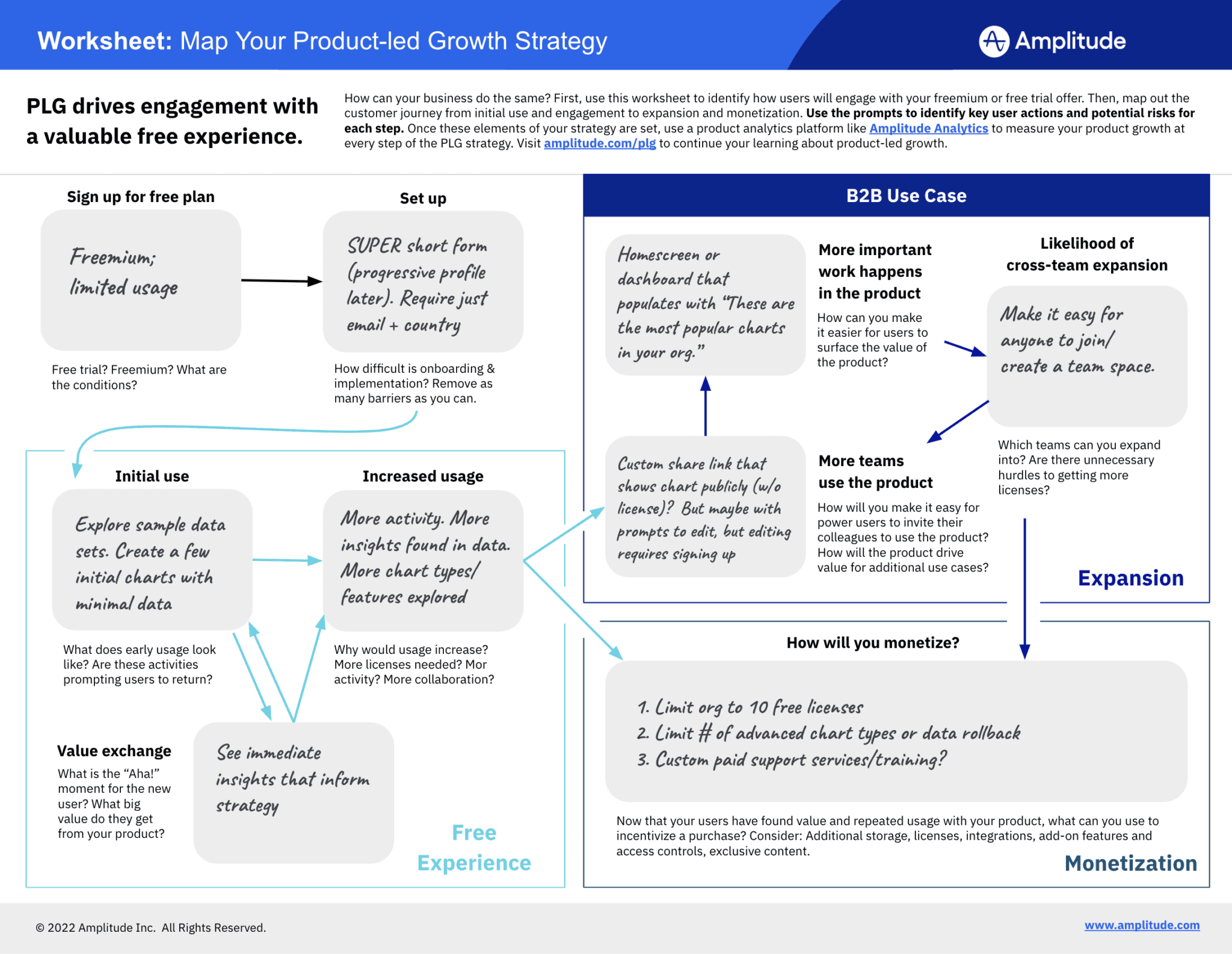
This preview shows how the worksheet might be filled out; the PDF worksheet you download will have blank text boxes to fill in.
You can also use this worksheet as a team-wide PLG exercise to:
- identify potential risks and barriers
- brainstorm ways to increase monetization
- diagram the “virtuous loops” within your product that strengthen engagement and retention
Product analytics platforms make product-led growth feasible
Reorienting your business around your product is no easy task, but it’s worth it to scale your business and increase profitability. Start by defining your North Star Metric and learn how to identify and amplify the growth loops—or flywheels—that already exist in your product.
Product insights give you an edge for product-led growth—and Amplitude is here to take your growth strategy to the next level. As you embark on your PLG journey, try the Amplitude starter plan to:
- Explore product insights
- Enhance user experience
- Track user behavior
- A/B test product features
- Personalize marketing messages
- And manage robust data
No need to swipe your credit card. If you need more features, we’ll be here to help take your product analytics to the next level. That’s product-led growth in action.

Mallory Busch
Former Senior Content Marketing Manager, Amplitude
Mallory Busch formerly ran the Amplitude blog, frequently named a best blog for product managers. She also created AmpliTour, the live workshop for beginners to product analytics and 6 Clicks, the Amplitude video series. She produced the Flywheels Playbook, wrote The Product Report 2021 and produced The Product Report 2022. A former developer and journalist, Mallory's written work and coding projects have been published by TIME, Chicago Tribune, and The Texas Tribune. She graduated from Northwestern University.
More from Mallory


