The Art of Impact Mapping: 4 Steps to Create Your Own Map
Understand the role of impact mapping in successful product development.

Browse by category
Impact mapping is a strategic planning technique to help you launch software products with the most desired impact. Impact maps help your product management and delivery teams and other stakeholders visualize and plan roadmaps to delivery. This is done by clearly defining a goal, understanding all actors involved, and identifying the behavior change needed to achieve that goal.
Software delivery consultant and author Gojko Adzic developed this visual process by mixing user interaction design, outcome-driven planning, and mind mapping.
Key takeaways
- Impact mapping uses techniques similar to story and mind mapping to outline and communicate the product development journey.
- You can use impact mapping for strategic planning, defining quality, and roadmap management.
- Impact mapping is helpful in a range of situations, including defining a vision for a new product or helping teams agree on which direction to take in the product development process.
- Creating an impact map involves four steps: defining a goal, identifying actors, agreeing on desired impacts, and choosing deliverables.
What is impact mapping?
Impact mapping is a visual planning process that enables your product teams to take a business goal and translate it into a tangible product deliverable or user story. This approach brings key people together to brainstorm and, ultimately, create a diagram that maps out how deliverables will achieve your desired user behaviors. It’s similar to story mapping and mind mapping exercises.
Product impact mapping is advantageous for the product development process because it:
- Requires a collaborative approach. Developing an impact map is centered around collaboration across various departments. From development teams to external funders, it requires every stakeholder’s input to ensure results tie back to business goals.
- Visualizes assumptions. There are no limits to the assumptions you can make—from how users will react to a change to the best features for a new product. Impact mapping’s visual nature helps communicate assumptions more clearly, which helps in the decision-making process. While creating your impact map, assumptions can be discussed, backed, or refuted.
- Helps you develop new products faster. The impact mapping process is easy to implement, and you can complete it in a few days during facilitated workshops or meetings. Once your impact map is complete, you can begin developing with more efficiency.
The purpose of impact mapping
Impact maps bring value throughout your organization, from the executive team to product development and customer advisory boards. You can use them for various planning and communication purposes.
Strategic planning
Business and IT teams can often be misaligned when developing a new software product. Impact mapping helps senior executives and technical experts find a mutual understanding of the product’s scope early on.
The impact mapping process helps business and IT teams reach common ground. This ensures that your development team builds products that align with company objectives get-go.
Defining quality
The impact planning process requires you to identify the desired technical deliverables early in product development. By outlining standards from the start, your teams can include quality improvement and assurance activities throughout the development life cycle.
You can perform tests specifically to ensure that your product drives the desired customer behaviors and is not limited to technical testing.
Communicating assumptions
Impact mapping provides a mechanism to communicate the product development process's goals, priorities, and assumptions.
Two main types of assumptions to communicate are:
- Your final product will lead to a behavior change in a customer.
- Once a customer adopts that behavior change, it will make it possible for your business to achieve its original goal.
Once you launch deliverables, you can track behavior and impact metrics and reassess and evaluate your strategy.
When to use impact mapping
There are several use cases for impact mapping. Different use cases require the involvement of different stakeholders, and you execute the process at different stages of the development cycle.
Create the vision for a new product
You can use impact mapping to establish a vision for a new product milestone—especially when you already know the solutions you need to implement. This use case is typical when an organization obtains a list of features from external clients or third-party agencies.
In this scenario, you invite all relevant stakeholders to a brainstorming workshop. A facilitator typically presents a general outline in the form of a business goal to start the process. The participants discuss actor impacts and eventually develop proposals for deliverables in the form of an impact map.
Align priorities for delivery
Impact maps are valuable when the objectives of an initiative are clear, but stakeholders have conflicting priorities. In these situations, impact maps help align priorities to help focus on a clearer path to delivery.
You typically need to create an impact map to align priorities when collaborating on:
- A large product that covers many different goals
- An ongoing initiative with a backlog of activities
- An initiative where teams are struggling to identify what’s not working
Here, facilitators encourage stakeholders and delivery teams to create the map collectively with a single goal as a jumping-off point.
Agree on direction through problem reframing
Sometimes a project’s objectives are unclear, or there are conflicting opinions. You can use impact mapping to reframe the problem and get your stakeholders to agree on the objectives.
Reframing is often necessary when:
- A single stakeholder has complex business knowledge.
- The outputs of a project no longer deliver value, or the project is stalled.
- You’re launching a new initiative but lack clear goals.
Problem reframing involves collecting information from multiple impact maps resulting from several meetings with different stakeholders. The facilitator captures and collects the different ideas and objectives and presents the results back to the key stakeholders. Based on this information, the key stakeholders make a final decision based on detailed goal metrics and high-level information.
Communicate a project
Impact maps are a great communication tool, whether you’re passing on a message or initiating discussion within your project team or with product owners, managers, and decision makers. Research-backed impact maps clearly show what a product needs to drive user engagement and adoption. This gives teams a strong template for designing solutions with the best business impact.
How to create an impact map
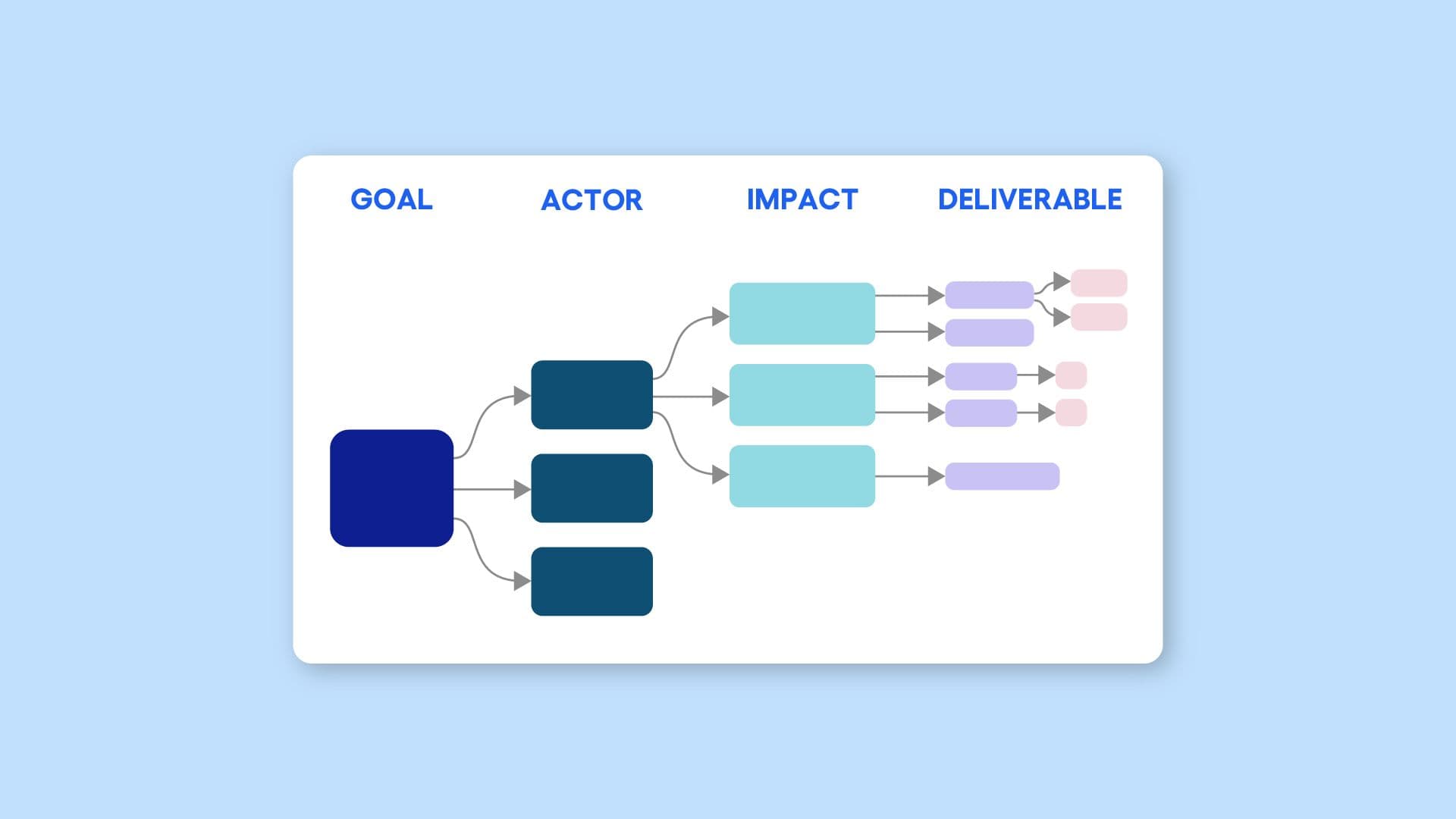
Impact mapping is a form of mind map that starts from one goal and then branches out to multiple actors, impacts, and deliverables. As you develop your impact map, moving through each step in this order is essential since one leads to the other.
1. Set goals
To start, ask yourself why you’re doing what you’re doing. What are the ideal outcomes you would like to achieve? This may seem simple, but it’s important to dedicate sufficient time to this step, as it influences every subsequent element of your result.
Your goal could be to increase product awareness, reduce churn, or improve customer lifetime value (CLV). The best goals are firmly grounded in data. Digital analytics tools help you identify what you’re trying to achieve with this new product. If the data shows you have a churn problem, then a churn reduction goal is most appropriate.
2. Identify actors
Once you’ve identified your goal, identify the people who can influence your product—also known as actors. Identifying your actors helps you pinpoint potential users, groups impacted by your product, and even those who can block your path to success.
Actors are more than just customers or potential customers—they include anyone with a role in your product’s life cycle. For example, actors can consist of your team members, strategic partners, and suppliers.
If your goal is to improve customer retention, one group of actors you should consider is your loyal customers. On the other hand, you should also identify those customers who are a churn risk, as these actors can block your path to success. Also, consider your customer success team since their interactions with your customers can make or break your retention efforts.
Data plays a significant role in defining your actors. By using a process like cohort analysis, you can make data-backed predictions about how groups of people or customer personas will react to your product. Cohort analysis makes these predictions based on historical data about prior behaviors. Predicting behavior allows you to segment different groups into the actor types most important to your product development process.
3. Agree on desired impacts
The next step involves determining your product's desired effect on your actors. How must the actors’ behavior change to help your organization achieve its goals? What changes can stop you from achieving your goals?
For example, if your goal is to increase sales, your desired impact could be for customers to purchase your product. Similarly, if you aim to improve retention, your impact could be getting more users to complete a task or action, like onboarding. Or, if you want to increase customer engagement, the desired effects might be customers spending more time using your app.
You can use funnel analysis to obtain insight into your current customers. By understanding your current customer journey, you can better decide what actions and impacts you need to drive to achieve your goals.
4. Define deliverables
The final step of an impact map is identifying what deliverables you need to produce to support the required impacts. Deliverables include the software features you need to develop or the activities your organization needs to complete.
If your goal is to increase customer retention, your deliverable might be a new gamification feature to boost your active users’ usage. Once you launch your deliverable, you can use your digital analytics solution to understand whether or not this deliverable achieves the desired effect or identify what you need to tweak to do so.
How does impact mapping fit within your product strategy?
When building your product roadmap, you can use impact mapping to keep your team on track. Impact maps help you identify features worth investing in and ensure development processes are relevant to business goals, adaptable, and easy to understand and communicate.
Robust insights into your users' product experience, preferences, and needs will improve your impact mapping process. A data analytics platform like Amplitude enables you to analyze customer data to understand where and how to focus your impact map for the greatest impact.
To learn more about Amplitude’s platform, try a free demo today.

Courtney Burry
Vice President of Product, Partner, and Customer Marketing, Amplitude
Courtney Burry is the VP of Product Marketing at Amplitude. Prior to working at Amplitude, she was SVP of Corporate and Product Marketing at Collibra and VP of Product Marketing at VMware. Courtney has 25+ years of marketing experience helping well-known tech brands evolve, grow, and thrive.
More from Courtney


